
Faith Against Authoritarian Regime
June 4, 2026
Dr. Nancy Bedford and Dr. Débora Junker describe experiences living under South American dictatorships, and how we can respond to the present political moment.
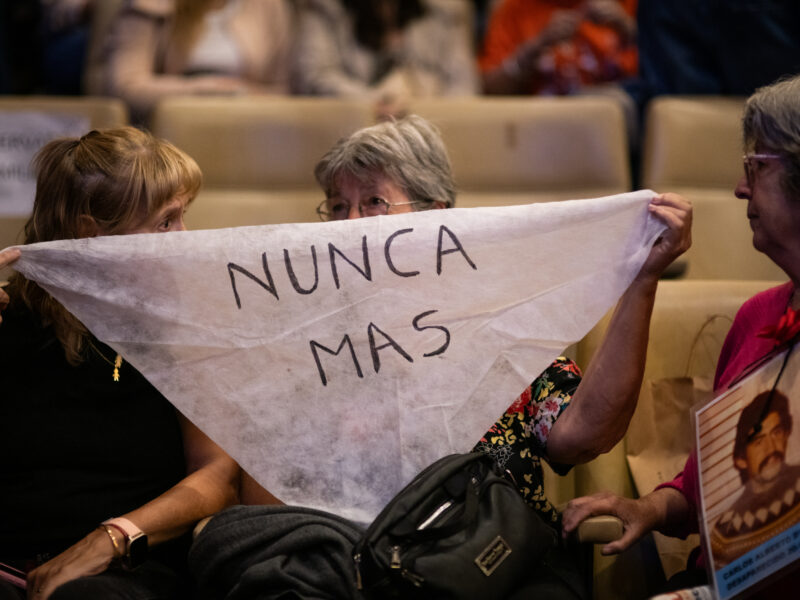
“When the coup happened, I remember people out on the street celebrating, hanging flags from their windows; it was a festive atmosphere. So here was a deep lesson to be learned: Anti-democratic coups tend to happen with the support of the middle class and large segments of the population.” Dr. Nancy Bedford, Garrett Seminary’s Georgia Harkness Professor of Theology, was a high-school sophomore in 1976 when Argentina’s military overthrew the democratically elected government. Her memories living under the ensuing dictatorship offer crucial insights for current U.S. politics; simultaneously an alarm against ascendant fascism and a potent reminder about the power each of us can wield to resist its rise.
There’s a common historical fallacy when discussing dictatorships, an erroneous assumption that people immediately recognize authoritarian rule the moment they begin living under its abuses. Dr. Débora Junker, Garrett’s Associate Professor of Critical Pedagogies, spent her childhood living under Brazilian dictatorship without knowing, let alone naming, this reality. “I was young and unaware of what was happening,” she recalls. “I do remember our father cautioning us that we did not speak against the government in this house. But growing up in a small town in the Brazilian Northeast, we had no idea of the political violence that was unfolding—not even when I first left for college.”
This gulf between historical clarity and a murky present is not an accident, authoritarian regimes go to great lengths to portray their actions as normal—even virtuous. “Many of the rich people made more money than ever, and were happy about the situation,” Dr. Bedford reflects. “To this day, some folks in our churches are nostalgic about those supposedly good old days of order, strictly enforced censorship, dress codes, and repression of alternative ways of thinking.” The Argentinian government immediately replaced the textbooks used in schools, saturated the television with slickly produced propaganda, portrayed universities as dangerous places where one’s children would become tainted by Marxist thought. “Authoritarians, no matter where they are, work to subvert the language, values, civic courage, local history, and critical consciousness from their people,” Dr. Junker explains. “And an even sadder part for me—both here and there—is how the church and Christians accommodated those abuses, exchanging the gospel of Jesus for power and profit.”
This perverse shroud is part of what enables authoritarian governments to commit heinous crimes without losing popular support. “Our churches were silent, as a rule. They were afraid to be vocal, afraid to be seen as anti-Argentine—the accusation leveled against anyone who tried to tell the truth of what was happening,” Dr. Bedford explains. “I remember a family in our church that always seemed very mournful, but I never knew why. Only recently did I learn that their son had been disappeared.” The government abducted dissidents—or anyone they suspected of disloyalty—routinely torturing and killing people without leaving a body or evidence of a crime; families forced to wonder while suspecting the worst. The government tried to bury these extrajudicial killings beneath a story of progress—the loudly professed, holy effort to return Argentina to greatness. “When people are politically disengaged and frightened, the authoritarian narrative manipulates how we think,” Dr. Junker notes. “It’s easier to simply follow the manuscript.”
This shared experience living through dictatorship compels Dr. Bedford and Dr. Junker to sound the alarm against where the U.S. government is headed. “We cannot normalize barbaric actions; cannot accept a cruel, oppressive, and dehumanizing social arrangement,” Dr. Junker says. “One of the most pernicious elements is the unconscious level of stress everyone begins to live under when you watch families ripped apart; children treated as if they were nothing; people deported as if they had not invested their life and health to work here. When the President makes wild accusations, promises that ICE will be in the streets, that repression will be violent—it’s easy to begin to self-censor, to think of your own safety instead of your neighbor’s.”
“We need to be very worried indeed,” Dr. Bedford says gravely. “If people can’t vote, present power structures will become even more entrenched. This isn’t just Trump; it’s the product of hollowing out our institutions over decades, of a mentality that says things are only worthwhile if they lead to making money.” Indeed, the erosion of civic safeguards is what allows the U.S. government to indiscriminately kill people in the Caribbean without due process, to award millions of dollars in federal contracts to oligarchic friends, to begin a war of choice in Iran without congressional oversight or approval. “The judiciary is enabling, the legislative branch is complicit, the executive branch is brazenly corrupt, and civil society is weakened,” she adds. “Humpty Dumpty has already fallen off the wall and the question for us is going to be, what can we try to build together? We can’t reassemble Humpty Dumpty, nor should we want to. Instead, how do we imagine a more just society where vulnerable people are at the center of our concern? We can help to do that as theologians, as people of faith.”
Dr. Junker points to her own journey from ignorance to critical consciousness as a sign that this transformation is possible. “It’s never too late to be educated and to educate others, to become critically aware of what is happening,” she says, cadence rising. “As a follower of Paulo Freire, I proclaim hope as the force that motivates, fights, seeks alternatives, resists, and does not remain silent. In a fearful moment and chaotic world, our task as witnesses and followers of Jesus is to insist that justice is for everyone, that dignity belongs to all people.” As a young adult, reading about the Brazilian government’s crimes changed how she understood both the government and her own responsibilities. The labors of people who researched, wrote, and organized under significant threat preserved the possibility of a different world.
Dr. Bedford points to the persistence of activists in Argentina as part of what enabled a return to democratic rule. “The careful documentation of the disappeared and the defense of human rights, as much as we could, is what later led to some accountability,” she notes. But she also celebrates the faithful witness of groups like the mothers of the Plaza de Mayo, who publicly gathered every week to cry out for the children disappeared by the government, praising their determination in a culture that demanded silence. “They were called ‘Las Locas de Plaza de Mayo,’ (the crazy women at the Plaza de Mayo),” she observes. “The patriarchy may have labeled them crazy, but at the same time they used their motherhood—a thing that supposedly this dictatorship was preserving—as a weapon, to say, ‘I’m looking for my child, a mother needs to know where their child is, how can you tell me not to ask?’ They were the bravest of all.”
Faith, in this context, does not minimize the horror of ongoing violence and repression, but also refuses to let that specter inculcate silence. “Any gesture of resistance—filing a lawsuit, a governor who stands up to the President, universities who find their spine, churches who find their voice, people who use whistles to signal the presence of ICE—empowers others,” Dr. Bedford says. “Authoritarians need the support of the masses, the ambiguous middle who have means and education and can become formidable opponents.” That, Dr. Junker concurs, is where the kind of education that people receive becomes especially crucial. “Education, Freire says in Pedagogy of the Oppressed, is the means by which humanity deals critically with reality and participates in transforming the world,” she says. “Education can uphold oppression, or it can nurture liberation. It’s what moved me from ignorance to action.”
The Cátedra Paulo Freire, which Dr. Junker directs, preserves this legacy by inviting students, pastors, and community members to study liberative pedagogy and reflect on how it can drive a spoke into the wheels of authoritarian violence. Recently celebrating its 10th anniversary, the center gathered to reflect on how art can affirm our moral convictions and inspire action. Dr. Bedford likewise praises the organic groups that have sprung up across the country to employ public singing to embolden democratic resistance. “Cultivating moral imagination allows you to later reconstruct our institutions,” she suggests.
But as Christians, we also affirm that personal piety is not a superfluous flourish. It is a constitutive part of how we resist violence. “Prayer and contemplation may sound weak, but they are central to everything that can help us resist in the way of Jesus,” Dr. Bedford concludes. “Contemplative prayer is the exact opposite of what would-be dictators do with their time, energies, and attention. The attention economy wants to distract you; the dominant system wants to scare you. Prayer focuses us—it reminds us that love casts out fear.”