

The Revolutionary Power of Art
May 27, 2026
Celebrating Ten Years of the Cátedra Paulo Freire
By Allie Lundblad
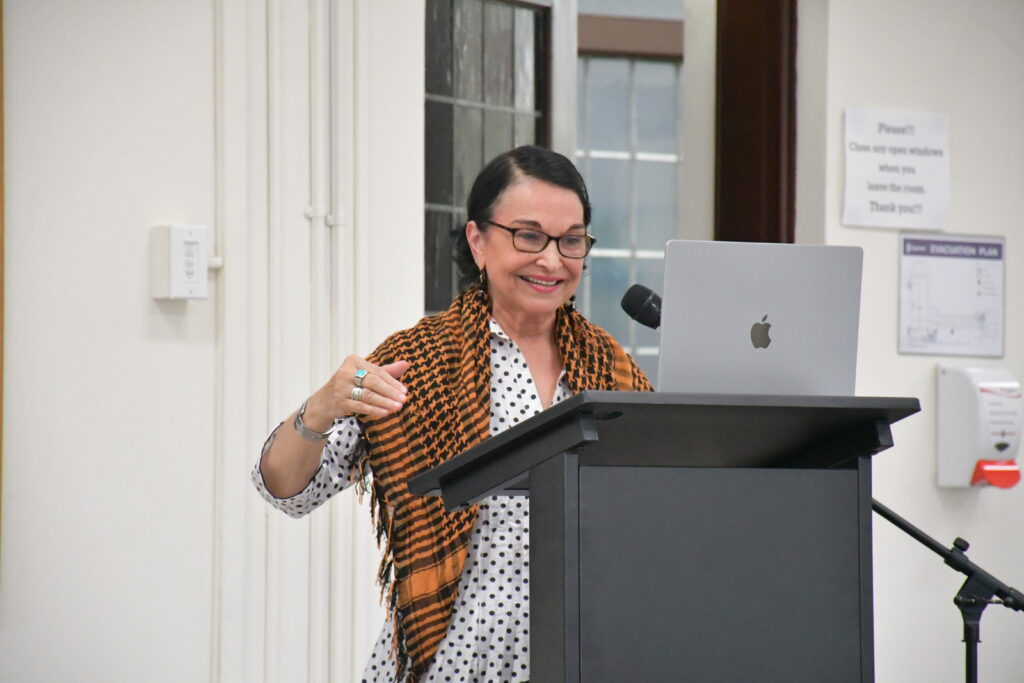
“This evening I want to stand before you not simply to speak but to bear witness,” said Dr. Antonia Darder as she began the first lecture at Cátedra Paulo Freire 2026. “To bear witness to the wounds that we carry, to the histories that have been buried, to the songs that refuse to die and to the sacred, insurgent power of art, spirituality, and collective healing in our lives that resides still in our bodies whether we realize it or not.”
Over the next twenty-four hours, Cátedra participants were invited not only to experience the “revolutionary power of art” — the theme for this year’s event — but also to recognize themselves as artists. After a Thursday evening lecture that explored the power of religion as both an oppressive and liberative force and the inseparability of liberative religion, spirituality and art, Dr. Darder began Friday morning by exploring the role of art in her own life. She spoke of coming from Puerto Rico to the United States as a young child with her mother, of meeting Paulo Freire at a conference by chance and being transformed by that relationship, and of having her heart broken late in life, offering examples of the art, her own painting and poetry, that helped her make meaning of all of these experiences. She described the capacity of artistic work to teach us about ourselves and our world while also helping us bring something new into being
“Art allows us to imagine and see ourselves differently,” she said. “This shapes how we act in the world. If we see ourselves as powerless, we act accordingly. If we see ourselves as empowered agents of change, our actions begin to shift.”
Afterward, Dr. Darder invited participants in person and online to spend time creating. She spoke of art as “a language of the soul” and asked, “What does it want to say to you that you haven’t been listening to?” An hour or so later, participants had produced paintings and drawings, poetry and dance, which they shared with one another. That afternoon, Dr. Darder brought the Cátedra to a close illuminating the possibilities of art for political and social transformation; a call for participants to reclaim its power. It was a powerful event for everyone involved, including event organizer Dr. Débora Junker.
“One of the unique moments was when she invited us to think about ourselves as an artist,” Dr. Junker said. “That recognition itself is revolutionary. Instead of deferring to the other, to the famous, to the acclaimed, to those already well established, we had to look to ourselves and had the opportunity to recognize the artists that we are.” But that moment is just the beginning. “If we remain within our artistic view individually, we will not accomplish something better and broader,” she continued. “That’s why for me the second step in this process is when we are able to come together and start doing art collectively. That is the moment that can really impact the time we are living in.”
That kind of communal work and bigger impact has been part of the Cátedra’s purpose since its inception. Dr. Junker, a 2003 graduate from Garrett, proposed the creation of Cátedra Paulo Freire when she returned to Garrett in 2015 as the director of the Latinx Center, now Centro Raíces Latinas. Her idea was to provide a space where faculty, students, and community leaders could further explore the significance of Freire’s writings within the framework of theological education. Bringing theology into the conversation helps to draw out the deeper political and spiritual themes of Freire’s thought, themes that can otherwise be all too easily lost.
“It is concerning when people treat Freire’s ideas as a methodology. The liberating education proposed by Freire is not a method; it is a conception of participatory and emancipatory education through which people become subjects who act to transform the world. The Freirean proposal is simultaneously problematizing, liberating, and humanist,” Dr. Junker said. “When we think of his pedagogy as a method, we dismiss not only the depth of his thinking, but we also fall into the trap of turning something that should be deeply rooted in our actions and our way of being into something mechanical and utilitarian. And in this way, we reproduce what Freire so vehemently opposed: a banking model of education.” It’s easy, she says, to create a circle and have a conversation without truly having “a dialogue where people enter with their histories, stories, and traumas.” According to Dr. Junker, “dialogue implies horizontality, problematization, questioning, and above all, the recognition of the other as a “human” and educable being. When we are able to see our reality and think critically about it, then we enter a process that Freire calls conscientization, and this process changes everything. It influences our perceptionof reality and should change our way of doing theology.”
The first Cátedra Paulo Freire, held in 2016, featured Paulo’s widow, Nita Freire, and event speakers since then have included Leonardo Boff, Peter McLaren, Henry Giroux, and Daniel Schipani. This year was the second event featuring Dr. Darder’s work, a choice that seemed particularly timely to Dr. Junker as she considered the public response to Bad Bunny’s halftime show and the power of art, in all its forms, as an act of resistance. These voices and others will be featured in a collection of essays, published within the next year, to celebrate the work of the Cátedra over the last decade. Dr. Junker hopes that moving forward there will be further opportunities for shared work and ongoing dialogue across the Garrett community.
The work of revolution is communal, after all, as Dr. Darder noted in that first lecture of the event. “Our revolutionary task is not only to critique but to create: new forms of spirituality rooted in justice, art that speaks truth to power, communities where our trauma is not exploited and where genuine healing is possible” she said. “Because in reclaiming art, in reclaiming our communal spirituality, in reclaiming our collective joy, we are ultimately reclaiming our humanity. Let us commit ourselves to this work not only as individuals but as communities inspired by resounding love, by the political grace of our collective power, and by our deep thirst for justice.”