

An Organic Approach to Theology
April 20, 2026
The Ecological Regeneration Certificate Program helps to nurture participants’ wide-ranging dreams and vocations
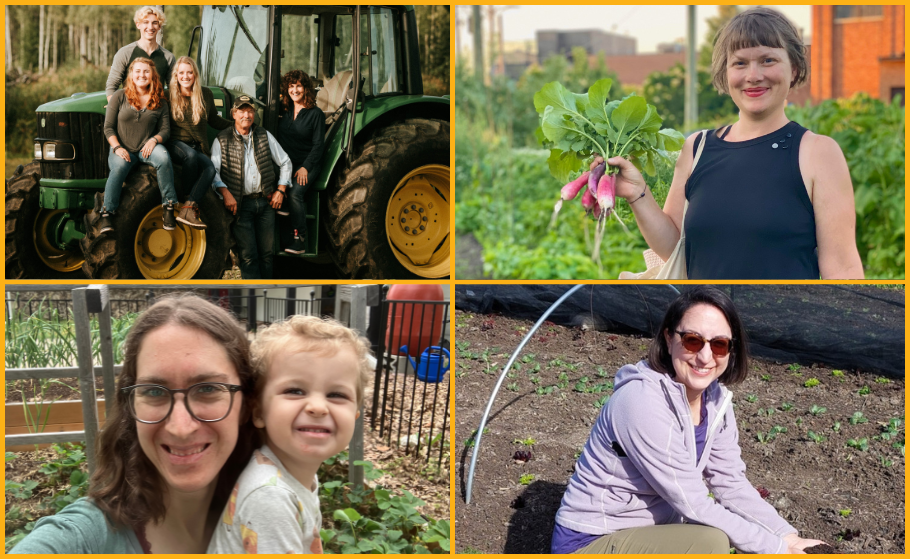
“It’s as if my intuitive faith has found theological validation. I can say that I’m a Christian and not feel like I’m faking it.” Like many people who grow up with a strong intrinsic connection to the natural world, Gina Tabachki also inherited a Christian tradition that drew firm boundaries between humanity and the rest of God’s creation. This separation left a fundamental alienation gnawing at the center of her religious life. A desire to mend that breach is part of why she leapt at the opportunity to participate in Garrett Seminary’s Ecological Regeneration Certificate Program, offered through the Center for Ecological Regeneration. The years spent learning and growing beside her cohort did help to integrate her theological and environmental convictions—but they also set her on a path of discernment and vocation she did not expect.
Offered online except for an in-person retreat, the certificate program is a series of five courses designed to give participants robust exposure to ecotheologies, an understanding of diverse approaches to land repair, and opportunities to design their own initiatives that plant justice and healing. Some students, like Rev. Brenda Kostner Johnson (G-ETS ’14), already have a Master of Divinity and are seeking specialized knowledge to supplement what they first learned in seminary. “Serving as a pastor, I felt a deep call and connection to creation,” she explains. “I was on family leave from the United Methodist Church and saw this as an amazing opportunity to nurture that side of me and weave it into my ministry.” For Sister Sara Tarango of the Sisters of St. Joseph of Orange, it was a chance to deepen her discernment as she prepares to take her final vows. “My current ministry is an environmental stewardship with Providence Health Systems, reducing carbon emissions and waste in healthcare,” she shares. “The sisters wanted to support that call with education, and this program helped give me space to dream.”
Other students enter the program without any theological background, drawn by a deep longing that can sometimes feel difficult to explain. Dr. Esther Seha is a political scientist but couldn’t shake the urge to explore her profession’s theological dimensions. “I’ve done environmental justice work, and I’ve always felt there was a spiritual foundation grounding it,” she notes. “I’m still a budding Christian, very much at the edge of things, but I see how we’re locked into unjust systems, mired in a spiritual crisis. So even though I’m very much a mind- and head-oriented person, I knew I needed to go past crunching numbers and get to the root of things.”
For Gina Tabachki, a transitional period in life was part of what pushed her to enroll. After her career in law, she was searching for new vocational opportunities. But other forces were also at play. She lives in Alaska, married to a partner who mushed sled dogs. To sustain that practice, the two cultivated a large farm with their family. “It was 185 acres, starting as a way to have a kennel for litters with almost 100 puppies,” she says. “Then the kids wanted horses, so we felt we had to raise hay. Then it’s a whole thing: You get chickens, you get sheep. There was always work on the land, offering an opportunity for family unity.” When she began the program, however, the kids were moving out; she and her partner were growing older, and questions about what to do with the farm loomed large. “We lived on that land for almost a quarter-century. But I’m 65, he’s 76, and none of the kids want to be farmers,” she says. “We knew we needed to sell, but it’s a lot of land and buildings so we didn’t know exactly what we’d do.”
If you speak to members of the ecological certificate program, you’ll hear a common refrain: Even when ecological work is tied to professional responsibilities, it’s always deeply personal. “I grew up on a farm,” Rev. Kostner Johnson names. “It’s mostly wheat farming and monoculture, so I have all these questions about what this could look like as a more regenerative space. But farmers hold deep connection to the Earth, and I inherited that gift.” For Sister Sara, reading the papal encyclical Laudato Si ignited a fire in her spirit. “My nickname is actually Sister Soil,” she says with a laugh. “God created humans out of dust for a reason, we’re built for enduring connection to the Earth.” That feeling of intimate connection doesn’t only seed passion, it nurtures resiliency. “It’s so liberating to look at humanity as part of a grand scheme of creation,” Dr. Seha notes. “Knowing we are created helps us stand in humility, while also recognizing our miraculous context.”
The certificate cohort is intentionally broad—gathering people across a wide array of life experiences and vocational intents—a biodiversity that strengthens any garden. In return, it offers guiding wisdom, concrete practices, and a community in which to share them. “What I love about the program is that I can immediately apply everything to my active ministry context,” Sister Sara reports with joy. “As a coach for the hospital green teams, I get so excited to help them achieve their goals. The courses help me bring theology into that work, to stir their hearts.” The program’s relational nature also kindles relationships that extend beyond the classroom—the four women in this article meet regularly, accompanying one another’s journeys. “Once a month we meet to discuss books we’ve read and nourish each other in our interconnected eco-spiritual journeys,” Dr. Seha says with a smile. “Without the program, I never would have met them.”
Rev. Kostner Johnson expresses gratitude for how the program and fellowship have enriched a season of discernment. “There was a time when I felt so alone for thinking about God and creation in this way. Now I realize there is already a community of thinkers, theologians, academics, and other students who were thinking the same things—I have language for my convictions,” she says. “I’ve found new space within the church and theology, connecting the threads of my life. The program inspired me to think about different ways to use my theological training, whether that’s in a local church or a non-profit. But whatever I do next, I want there to be an ecological connection.”
Gina Tabachki found an answer to her longing where she least expected. “In one class, they took us through the process of creating an imaginary non-profit. And I was a little skeptical because, if I’m honest, I think the world already has too many non-profits,” she chuckles. “I looked around my community and found Native Movement, a state-wide, Indigenous, youth-led organization who are intentional about land settlement and thought, ‘I’ll dream about an action fund for them.’”
A month after that class project finished, her realtor called and asked if Tabachki was familiar with an organization called Native Movement, who was interested in purchasing her family’s farm. “In an attempt to adapt to climate change, they wanted to grow food on the farm, train farmers, and send them out to villages,” she says. “The Spirit was leading that land to go back, and we were able to respond to Native Movement’s needs.” Now, she’s in regular communication with the organization, answering questions about the land and buildings which have been transformed into the Nankat Wellness & Resilience Center. “It’s such a big place, we couldn’t write a manual for everything. Now, we have a relationship, instead,” she says with joy. “If my sole purpose at Garrett was to respond to Native Movement’s desire, that alone would have been enough. I’m so grateful for this program.”