

A Shared Ecology of Formation
May 26, 2026
Reflections on a Weekend for All Creation
By Cassidhe Hart
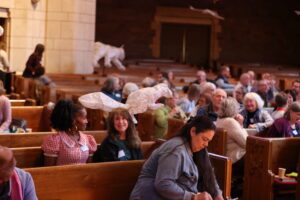
Participants gathered in the expansive 150-year-old sanctuary under the sheltering wings of a giant butterfly. When Rev. Elizabeth Macaulay, senior pastor at Hennepin Avenue United Methodist Church, drew attention to the hovering monarch hanging above, there was an audible gasp from the crowd. Mary Plaster, a Minnesota-based artist and activist, had assembled a “great council of beings” in the form of animal sculptures to oversee and surround the participants during the weekend’s events, calling all who gathered into awareness of their kinship with all creation. For All Creation—this was the theme for the April 18th-19th weekend, both a celebration of existing relationships and a commission for future unfoldings.
The two-day gathering was grounded in a dynamic partnership between Garrett Seminary and Hennepin Ave. UMC, held together by shared commitments to social and ecological justice, theological education, and spiritual formation. In his opening welcome on Saturday morning, seminary President Javier Viera shared that the now 3-year partnership grew out of a conviction that “theological education is most alive when it is connected to real communities.” He described the work as “a shared ecology of formation” and invited participants “not just to an event, but to a living experiment.”
Saturday’s gathering brought together scholars, community activists, advocacy groups, and area artists around the belief that the ecological crisis is a spiritual crisis requiring spiritual responses. Dr. Timothy Eberhart, Director of Garrett’s Center for Ecological Regeneration, shared that the organizers were guided by a vision of flourishing “for all people, places, creatures, forms, flows of energy – for all creation.” He expressed his hope that those gathered would nurture new partnerships and inspire one another to engage in faithful action “toward the better future we believe is still possible.” That hope took on flesh throughout the day as partner organizations – like The United Methodist Creation Justice Movement, Minnesota Interfaith Power and Light, Project Sweetie Pie, and the Women’s Environmental Institute – invited others to join their ecological initiatives and to organize with the communities and coalitions they represent.
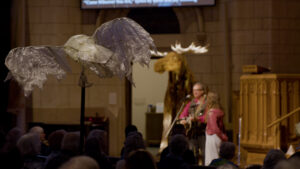
The event’s location in downtown Minneapolis in the wake of Operation Metro Surge was not incidental, as the energies of hopeful resistance and fierce love of neighbor flowed into the songs and liturgies woven throughout the day. Local singer-songwriter Timothy Frantzich and his daughter Esther led participants in forms of community singing that have resounded throughout the Twin Cities in recent months. The words to one of the songs – “no one is getting left behind this time…we get there together or never get there at all” (Joshua H. Blaine) – took on new meanings in the company of Plaster’s bear, moose, and other animals, many of whom have been carried through city streets as signs of both celebration and protest.
The first speaker, Dr. Matthew Fox, began by expressing how inspired he’s been by the Twin Cities community and framed his presentation – “A Christianity for All Creation” – in light of the profound need in our time for spiritual transformation. A renowned eco-theologian and author, Fox shared a dream in which he heard the message: “There is nothing wrong with the human species today except for one thing—you have forgotten the sense of the sacred.” Emphasizing the all in “For all Creation,” he spoke of Creation as our original cathedral and emphasized the need to return to a theology that begins with the goodness of the universe. Rather than continuing to fixate on human redemption alone, he called for a restoration of the fullness of a Christian witness that includes creation, redemption, and sanctification for all. If we can begin here, he claimed, “with the cosmos as something good and beautiful and a gift,” we can move toward a Christianity of and for all Creation.
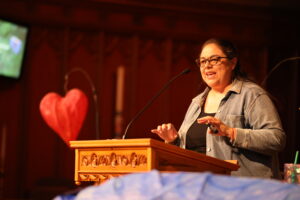
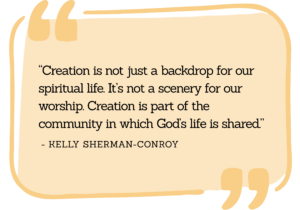
Dr. Kelly Sherman-Conroy, a Lakota theologian, pastor, professor, and storyteller, invited attendees into a lived remembrance of the connection we share as creatures of the Earth. In her presentation – “A Dakota Way for all Creation” – she called listeners again and again to be present to our breath and our common air. “The story of Creation isn’t only about what we do to the Earth but about what the Earth and all that is on it continues to offer within the life that we share.” The Earth, she said, relates to us whether we attend to her or not, but we have the choice whether or not to linger, to be moved, and to be transformed and opened to the fullness of reality. “When we stop and attend, we discover the truth: we are already in relationship.” When we truly open ourselves to the connection that is both our birthright and our charge, we cannot help but wonder what it means to be good relatives to each other. For it is by slowing down and learning to be present, Sherman-Conroy explained, that we come to know that “the world is not made up of objects,” but instead “a world of relatives with whom we share life.”
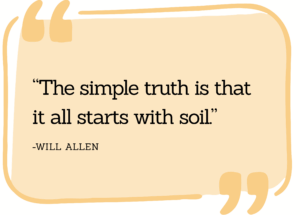
In Saturday’s final presentation – “Growing Food for All Creation” – Will Allen shared how emerging models of locally grown food and sustainable agriculture can be a revolutionary base for community empowerment, racial justice, and economic opportunity. Allen, a farmer, author, and winner of multiple awards for his work, spoke about his background growing up with his farmer grandmother and his sharecropper father and of his return to agriculture after a successful career as a professional athlete. Picture after picture told stories of determination and innovation, proving that another world is indeed possible through vibrant creativity, tireless imagination, and community-scaled technologies. Allen’s work, which has impacted communities in Milwaukee, Chicago, the Twin Cities, and around the world through the growing of healthy, accessible food, provided a fitting culmination to a day filled with creation-centered inspiration and place-based calls to action.
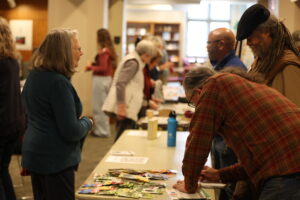
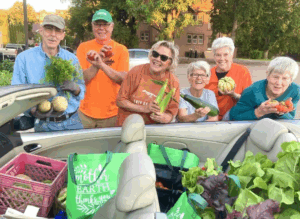
Whereas Saturday’s gathering represented what the Garrett-Hennepin partnership has enabled and seeks to inspire throughout the region, Sunday’s worship service was a celebration of the partnership itself. Members of the congregation spoke alongside members of the Garrett community – about eco-theological classes, regenerative gardening, solar panel projects, resiliency hubs, new models of theological education, and partnered dreaming – all pointing to the power of mutual collaboration. As President Viera shared: “for three years, in partnership with us at Garrett Seminary, you’ve been cultivating something genuinely prophetic. You’ve invited us,” he said, “to walk alongside you, to be embedded in your life, to tend together the soil which has been entrusted to you, to learn together, to discern together, to risk together. And in that mutual accompaniment, something remarkable has emerged.” Hennepin member Ginger Sisco, a leader of the congregation’s Creation Collective group, affirmed that “perhaps the greatest gift of all these creation care gathering points is the bond built between us, so we have community around us when the times we live in demand more kindness, compassion and attention.”
Eberhart spoke last and invited congregants to imagine themselves in the future, one in which “the global community has averted worst-case scenarios.” Widespread, democratic movements have helped usher in “a deep transition toward the healing of earth’s systems,” and political and economic systems have been “re-oriented around health, happiness, and equity.” And then, he said:
“The Garrett-Hennepin partnership, rooted here in the Twin Cities, with partnerships connected across the region, and around the world—we played a key role. What began as a conversation led to a class, which led to a collective, which led to gardens and solar panels and advocacy and a weekend celebration—with a moose!—and a lot of inspired dreaming, which led to… well, you tell me, what happened next?”
What happened next? What artistic visions flourished from Mary Plaster’s Council of Beings and Timothy and Esther’s soul-filled music? How did the vision of a creation-centered Christianity transform local congregations and their practices of ministry? What emerged when neighbors learned to slow down and pay attention, together, to the creaturely kin all around? What solutions grew when communities rethought land use and began to grow healthy food for the wellbeing of all?
The partnership between Hennepin UMC and Garrett, the emerging work of the Center for Ecological Regeneration, and the community partnerships proliferating and cross-pollinating all embody hope for a future where the flourishing we experience is for all creation, from soil to sacred breath to soaring butterfly.
Hennepin UMC is one of nine congregations that have partnered with Garrett in the Hope for Creation curriculum, a 15-month earth-based exploration that empowers and connects churches to partner with the communities of which they are members – social and ecological – for the mutual thriving of all. Hennepin’s journey through this learning experience both undergirded the weekend event and strengthened them to reach out for community connection. To learn more and to join the work: