

Your Call Is Within Reach
September 15, 2026
Efforts to increase access and affordability to Garrett’s degree programs are helping more people enter theological education.
“I want to be faithful to God.” Rev. Michael Madden serves Shelbyville First United Methodist Church as a locally licensed pastor. His story is increasingly common. A second-career minister, he long felt called to ordination as a UMC Elder but struggled to live into that vocation while balancing the logistical requirements that road often demands. This fall, he begins his MDiv at Garrett Seminary without accumulating significant debt or uprooting his family—a decision made possible by a significant tuition scholarship and a robust online education curriculum that enables him to complete his degree while continuing to serve his church.
“As Garrett welcomes its largest seminary cohort in more than two decades, we are witnessing the fruits of a years-long effort to make theological education more accessible and affordable,” says Scott Ostlund, Garrett’s Vice President for Enrollment Management. “Learners are eager to follow their calling, but they can’t do so unless institutions think about how we can remove structural hurdles. We know we still have work to do at Garrett, but our growing student population reflects the strong effort we have made to remove academic, financial, and contextual barriers. This energizes us to prioritize accessibility even more in the future.”
Enrolling in seminary is a huge decision, even for people who have spent their lives serving churches. Joelle Brummit-Yale is the Director of Children’s and Youth Ministries at Chapel in the Pines Presbyterian Church. “When I started doing this work, I realized I needed more theological training,” she says. “I looked at seminary and thought, ‘wow, that’s just too much.’ I had a young child and was just entering the field, so I decided to get a certification in Christian Education.” Years later, with her son heading off to college, she realized the moment was right to reconsider seminary and came across a unique opportunity: Garrett’s Laity Discernment Cohort. “That was huge—to take a low-cost class and test it out to see if I could do it,” she reflects. “But even more, I appreciated the chance to have in-depth conversations about my call. They were incredibly kind, nurturing, and open.”
The LDC is just one way that Garrett facilitates ministerial formation. Our expanded Great Lakes Course of Study program offers another pathway, helping United Methodist locally licensed pastors move deeper into theological training. “If you complete your Course of Study through Garrett—the school will count it as a third of your MDiv! What a gift,” Rev. Madden expresses with relief. “The admissions office is so good about piecing together which course correlates with which, so I won’t have to redo things I’ve already done.” A new Deacon Discernment Cohort offers yet another opportunity for UMC lay leaders.
Garrett pairs these discernment opportunities with the ability to complete several degrees, including the MDiv, fully online. “Location was a big deal because we live in North Carolina and our roots are here,” says Brummit-Yale. “My husband owns a small business, we cannot pick up and move.” For Rev. Madden, the demands of church and family likewise prohibited relocating to Evanston. “I wasn’t going to wreck my family over my education,” he says bluntly. “I knew if I was going to be a full-time pastor, full-time student, full-time parent, and full-time husband, I couldn’t do all those things. The temptation is to let family obligations slide, since they’re going to be there for you. But that doesn’t feel like what it means to be faithful.” Taking classes part-time enables him to complete his MDiv without sacrificing what’s most important.
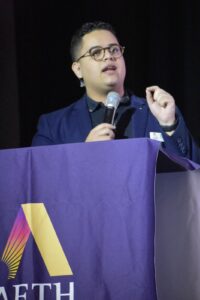
The ability to learn online also dramatically increases the number of students in Garrett’s classrooms who study across wide geography. “Remote education doesn’t only help us grow theologically, it brings perspectives like mine into the room,” says Jeremy Villoch-Galarza, who joins Garrett from Puerto Rico. “As seminary education becomes more accessible, it enlarges community. Last semester we had students in class from all over the world—gathered across time zones and geography.” For Villoch-Gallarza, it’s also about staying rooted in the communities that shaped him. “It would have been very expensive to come to Evanston, though I considered it,” he says. “But I would also have to leave everything behind, and that would be more complicated to do.”
For Brummit-Yale, students like Gallarza are part of what drew her to Garrett. “Other seminaries were more convenient, but the student body wasn’t as diverse,” she explains. “Now, I’m in class with people who I never would have met. It makes my faith life and work so much richer to have their experiences at the table.”
Accessible pathways are only half the equation, however. As Gallarza notes, higher education is expensive. “Without a scholarship, I just wouldn’t be able to do this,” notes Rev. Madden. “I could take on more debt, but it would leave my family in a very difficult financial situation.”
Lightening that yoke doesn’t only help students pursue new ministerial vocations. It strengthens ways they already serve. Erin Lorenz works for the Minnesota Annual Conference of the United Methodist Church. She has also been active in congregational efforts to resist ICE deportations and volunteers with the League of Women Voters. She was interested in Garrett’s Master of Arts in the Theology and Ministry to improve her effectiveness in all those roles but couldn’t justify that investment of time and energy if it also created an economic burden for her family. “You don’t get into the ministry field for money,” she laughs. “It’s not like law school, where there’s a clear path to recoup a financial investment. “But I know what I will learn in this degree will help me do more community organizing with our church and I’ll be able to apply the knowledge to how I serve the Conference. I am also eager to see how my education at Garrett will connect with the work I do with the League!”
It’s her second time pursuing a degree online—she studied remotely two decades ago for her bachelors—and she’s been thrilled to see the ways that online education has improved in that time. “I really appreciated during orientation week how every session leader was very intentional about inviting online students to contribute, and they always had someone monitoring the chat for questions,” she shares. “Often, they’d say, ‘let’s start with remote students!’ We never felt like an afterthought.”
That experience extends from orientation into the classroom. “Even though we were not in the same space, it very much felt like we were,” says Brummit-Yale. “We were forming relationships and people brought their authentic selves into the room; they didn’t hide behind the camera.” Garrett intentionally schedules classes to accommodate a variety of time zones, so the global church can show up together. “I don’t know exactly what that magic is,” she laughs. “But Garrett is finding it.”
The seminary’s commitment, however, is for remote students to have an equal experience to their in-person peers, and we know work remains to realize that goal. “We’re working hard to develop the networks and strucctures we need for field placement opportunities for remote students, and to the increase interpersonal and emotional support systems for them as well,” says the Reverend Dr. Jennifer Harvey, Garrett’s Vice President for Academic Affairs and Academic Dean. “We want every learner to have what they need to flourish, no matter where that learning takes place.”
Infrastructure improvements are also important. “Sometimes, in the current rooms, we can see other students but it’s hard to hear them,” Brummit-Yale notes. “And it’s hard to see the speaker’s face unless they’re also on Teams.” Our strategic relocation on Northwestern’s campus will help. Beginning Fall 2027, modern classrooms will enable us to update our technology, as we work toward full educational equity.
That goal may lie ahead, but it’s clear that affordable and accessible education already makes a tremendous difference for learners and communities. “I took Intro to Old Testament while I was also teaching those texts to children, and it made me so much more confident as I worked with the kids,” Brummit-Yale observes. “Now I know more layers and have access to more resources to examine them.”
For Rev. Madden, that thriving looks like continuing to shepherd his church in Shelbyville, Illinois while he studies. “They have an incredible food pantry they started, which now operates out of a building across town,” he says with pride. “It’s such an operation. They are efficient. They are compassionate. They do incredible work.” He’s thrilled to receive new training to provide spiritual sustenance that fuels this faithful service. “I know this degree is going to push me. It’s going to challenge me,” he says with conviction. “I do my best work when I’m challenged. It’s going to make me stay motivated, instead of burying my talents in the ground.”