

Public Health is Church Work, Too
February 11, 2026
By Benjamin Perry
“There is a saying: When you are healthy, you belong to yourself; when you are sick, you belong to the community. So, when one person is unwell, the community is not well.” As the Reverend Dr. Kenneth Ngwa speaks about public health, he habitually blends African hermeneutics and cutting edge research—a synthesis that shapes Garrett Seminary’s Religion and Global Health Forum (RGHF), where he serves as director. Now, however, his voice also carries a palpable anger and sorrow for policy decisions that endanger and end people’s lives. “What is happening in the United States is unfortunately an encounter with most people’s experience of healthcare throughout the world,” he says gravely. “I grew up in a country where individuals are left to fend for themselves, where government does not help people but pushes them further to the margins to amass privilege for a few—which is what is currently happening in our health sector.” Amid a broken infrastructure, he believes churches and clergy can play a pivotal role helping people to access care, mending tattered relationships between vulnerable communities and medical professionals, and boldly speaking out for desperately needed change.
As Dr. Ngwa notes, in countries like his native Cameroon, people are often forced to make costly decisions between accessing healthcare and other basic subsistence needs—a devastating choice that millions of Americans now face. “When people can’t afford healthcare, they don’t go in for early checkups or routine screenings, and you end up with many deaths from preventable diseases,” he says. “But there’s also an issue of trust: Social relationships must be grounded in an ethic of empathy and care—qualities that have been violated by the medical apartheid that has existed for Black people and poor people in this country and around the world.”
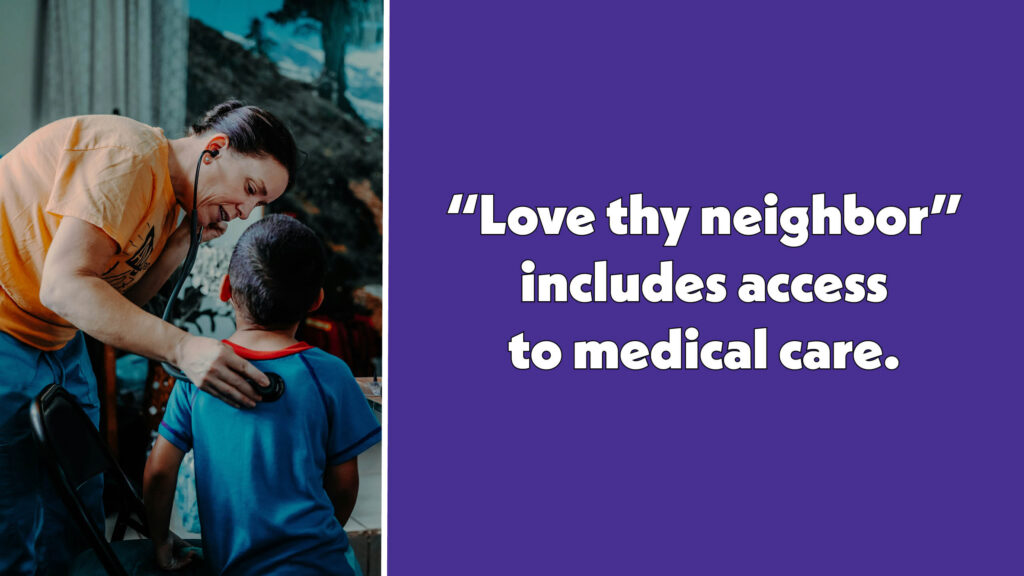
Churches and ministers are uniquely positioned to address both crises. “There’s a built-in trust that Christians have with their clergy and other parishioners,” he observes, “If you look at most pews, you will find medical professionals sitting there. Let’s use the medical expertise that God has planted in our midst! Then, it’s not someone coming from outside to talk to you, it’s the medical professionals who sing the same hymns as you, who pray and read the Bible with you.” Hosting medical Q&As can be a way to cut through swirling misinformation, but Dr. Ngwa believes that clergy also have a responsibility to help congregants receive treatment. “Churches can also work with medical facilities to create opportunities for medical professionals to come and offer primary healthcare services,” he says. That way, the church becomes something of a “health hub.” This vision is being developed by the RGHF in partnership with the Global Health Catalyst, a concept that has been published in Nature Medicine.
“The Good Samaritan parable also includes conversation about cost and payment. The Samaritan says, ‘Whatever costs you incur, I will pay.’ So at the RGHF, we also help clergy and churches think about what it might mean to include healthcare costs in their budget.”
The RGHF uses the acronym C.A.R.E. to help religious professionals think through these issues: First, congregations can connect people with “Care.” Second, they can be an Advocate against the death-dealing circumstances that currently afflict far too many. There are also opportunities to participate in Research. “At the National Institute of Health, there is work being done about the importance of spirituality and whole person health,” Dr. Ngwa notes. “It would be fantastic if churches and clergy decided they wanted to be at the forefront of this work.” Lastly, they can Educate through health campaigns, increasing awareness about prevalent diseases and developing communal responses. On February 24, Garrett’s monthly Let’s Talk Globally conversation will feature Dr. Ngwa speaking with Kudzanai Muzarari (an MDiv student with a passion for health advocacy) and Makengo Olivier Sundika (an MAPCC student and former medical professional in Zimbabwe). Together, they will help students discern how congregations can weave these four responses to expand sustainable healing.
In this season, however, Dr. Ngwa believes that clergy and churches also have a moral responsibility to confront those in power who perpetuate harm. “The administrative approach has been ruthless and cruel,” he observes bluntly. “It has taken a razor to one of the basic fabrics of human existence.” This is certainly true within the United States as people face rising premiums, but it is even starker abroad where the closure of USAID has already killed hundreds of thousands of people. “U.S. bureaucracy is massive, and when you bring its power down heavy on the world, the consequences are brutal,” Dr. Ngwa explains. “In Sub-Saharan Africa, for example, what this means is people no longer had access to medication that kept them alive. Thousands and thousands of people have died in the Congo, in Cameroon, in Zimbabwe. Millions of more people will, if nothing is done.”
Continuing to reflect on the Good Samaritan, Dr. Ngwa observes that one group is conspicuously absent from the parable: The people who attacked the traveler in the first place. “Clergy have a responsibility to name and force people to see who or what has committed this crime,” he contends. “Part of the prophetic work must be to consistently raise our voices about the policies that are causing this devastation, to talk about the implications of what it means to cut off humanitarian funding or to hollow out medical expertise at the CDC.” Clearly identifying the harm is also essential for determining how we can mend it. Dr. Ngwa and the RGHF are currently exploring ways that the center can work to connect philanthropic organizations with international communities, to ensure that medical aid goes where it’s needed most. “We have to imagine what comes after this,” he determinedly concludes. “Clergy must lean into this space and lead.”