

Invisible Mask: An Interview with Dr. AHyun Lee
November 20, 2025
Allie Lundblad
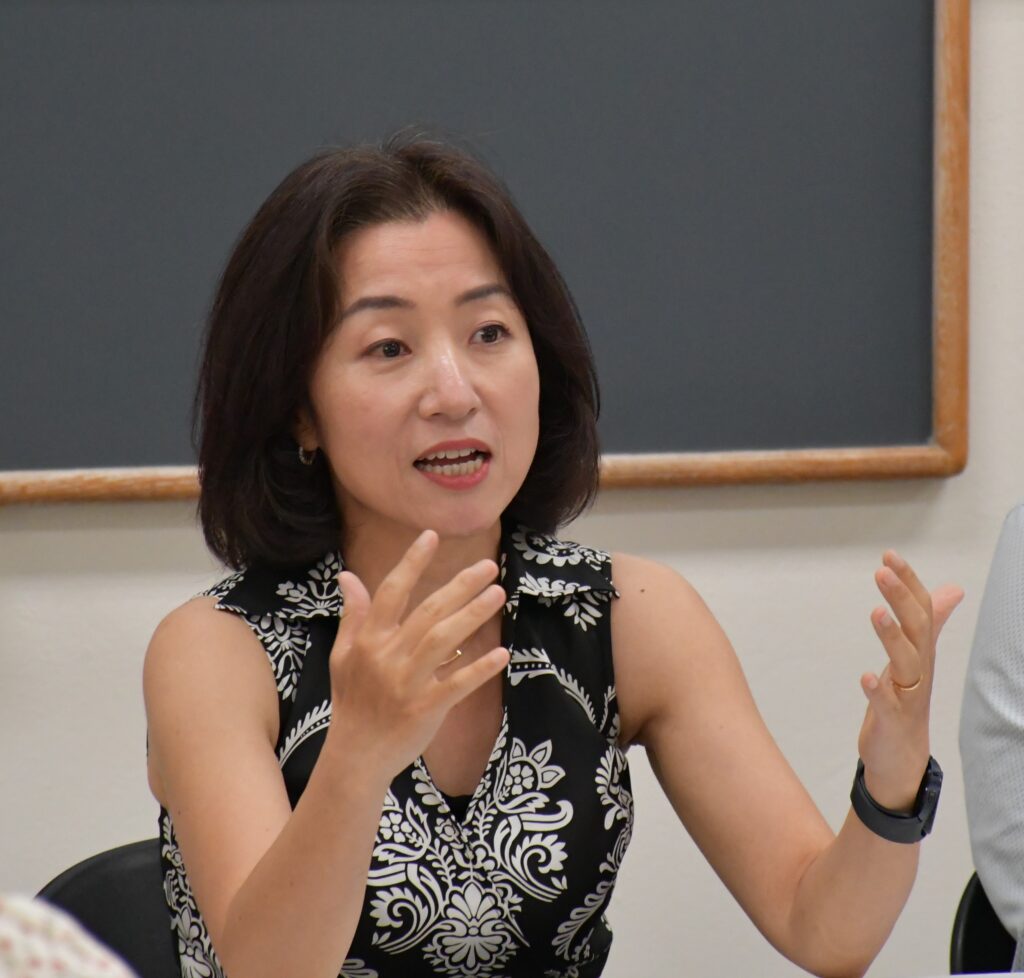
You might think Dr. AHyun Lee’s new book Protestant Clergy Sexual Abuse and Intercultural Pastoral Care: Invisible Mask has nothing to do with you or your church. “You might think, ‘My church didn’t have that kind of traumatic experience,” she says. “But here I want to invite a different question: ‘If I’m wrong, how would I know and are we ready to respond?”
The conversation about clergy sexual abuse is, after all, an uncomfortable one many of us would prefer to avoid. That discomfort is mirrored in the academy. Dr. Lee found that research spikes after highly publicized cases and then dissipates as attention fades. In the cases she studied, she also saw how quickly churches moved to cover up abuse. She hopes her new book will invite a fuller, sustained conversation, that together we might have “the courage to tell the truth about clergy sexual abuse and the courage to imagine the church as a safe place again.”
I was grateful to have an opportunity to talk with Dr. Lee about her new book and what she hopes pastoral caregivers and church leaders will learn. An abridged version of our conversation is below.
—————
Allie Lundblad (AL): Dr. AHyun, thank you so much for speaking with me! Could you begin by briefly describing your book?
Dr. AHyun Lee: My case study is focused on Korean protestant churches, not only those in Korea but also in the United States and in diaspora congregations across the world. The reason I’m saying case study is that it’s one case that shows us how culture and theology impact any form of harm or violence, and how we can explore healing and care together. All the complexity can be explored, because it is not only in the Korean church. You can also apply these ideas to your own context, because patriarchy, heteronormativity, militarized leadership style, purity cultures, or colonial missionary legacies, impact any faith community.
AL: Why was it important to you to examine clergy sex abuse specifically in Korean Protestant churches? And how did the particularities of that context affect your conclusions?
Dr. AHyun Lee: In psychological thinking, culture is not just something out there, right? We internalize it, live in it, with it, and for it. It’s related to your belongingness, your sense of self, or your self-worth, so it’s not a simple layer when you talk about culture. Think about whiteness in U.S. churches, patriarchy, or even how productivity becomes a virtue in our current capitalistic system.
For example, in my ordination process, I had been told to introduce myself in military style. While other colleagues were preparing for their interview based on the content, I had to stand in the corner, practicing military-style introduction, because I didn’t go to army. In Korean culture, army is mandatory for men, so for a male-dominant culture, that’s a very normative thing. That’s a simple example, but it shows how the church and culture are connected. This book starts with the Korean context, my own experience as pastor or leader, but at the same time shows how culture is involved with analysis of abuse and how church culture can victimize people. That’s why I called it an invisible mask.
AL: Let’s follow that concept of invisible masks. You talk about these invisible masks that obscure the realities of the situation. What are those masks and how do we recognize them?
Dr. AHyun Lee: This book comes from listening to stories of abuse in our faith community for many, many years. During the pandemic, when we were all talking about masks, I started reflecting on the masks we cannot see. Invisible masks are the ones we wear sometimes without even realizing. The perpetrator hides behind spiritual authority, and institutions hide behind their reputation. Congregations hide behind harmony or the idea of a family. Survivors often hide behind silence for the sake of safety. As with actual masks, these masks cover but do not erase what’s underneath. Eventually, what is hidden comes out whether we are ready for it or not. The question is, will we unmask together as a community or will survivors and victims be left to carry that burden alone?
AL: What do you hope that church leaders and pastoral caregivers will take away from reading your book?
Dr. AHyun Lee: When we talk about pastoral care, we talk a lot about centering care-seekers. The implication is that you are going to hear their story, right? The assumption is right there. But what if the person is not even able to say anything? Then what does it mean to center victim-survivors?
I hope leaders and caregivers will think about what it means to center victim-survivors and reframe that idea. It’s not the responsibility of individuals who need to speak up about their pain and ask for change. It’s more a need for communal accountability. It’s important for church leaders and caregivers to have some training about a trauma-informed approach. Because you are not just talking about one person’s trauma, but how all those traumas impact the community. That’s one thing. Also, those things easily become institutionalized to protect the church’s reputation, so you need to be aware of policy changes, accountability processes, good rituals, the use of language in the sermon or in the bulletin. It’s all needed.
AL: Do you have specific advice about how churches can center the experiences of victim-survivors in ways that are healing and not re-traumatizing?
Dr. AHyun Lee: Most of the victim-survivors of clergy sexual abuse take decades to begin to speak about it. You need to understand, it’s a long journey. Because it’s a long journey for the victim-survivor, their identity is not stuck with the one identity. Their identity is victim, but at the same time, survivor, but at the same time, coper, but even thriver, too. Understanding that plurality and thinking about their current moment and need — honoring their need, their pace, their choice — is crucial when you are providing care for victim-survivors.
This issue also comes with a lot of different complexity and intersectionality. For example, one of the studies I did was a case where the family was undocumented. Usually, in immigrant contexts, church is the first place they get support and resources when they move to the United States. When that church becomes the place of abuse, then there’s no place they can go because of their status and, worse, they lacked resources and language access. Church is the cultural support place, financial support place, legal support place, language support place, too. So, the other part we need to think about is what kind of resources or support systems we can provide.
It’s usually not about helping individual victim-survivors. It is about asking how the whole community of faith can heal. Rather than focusing on those who are victims, understand that this is a big, long journey and focus on how churches as a whole community can seek healing together along with the victim survivors.
AL: How do churches do that? Seek healing for the whole community?
Dr. AHyun Lee: People often misread clergy sexual abuse as romance. It is not. It’s about power, so analyzing power dynamics in the church context is crucial to providing care. That’s not just power dynamic analysis. It’s also about who the leader is, what kind of voice is heard, how they make decisions, what kind of transparency policy there is. Analyzing those things is crucial as a pastoral caregiver.
In the church context, always be intentional about creating rituals of lament and truth-telling processes, making space for people to express their emotions, saying things out loud, even joyful things out loud. Make intentional space when you are sharing joy and concern, rather than just sharing who is sick and praying. Make a place where those things can really be shared and accepted. Intentionally inclusive language is crucial. And of course, creating policies and external partnerships of support and accountability is important too. Those are so important, because as I mentioned, it’s a long journey for victim-survivors and it’s the same way for the church. It’s not a one-time thing, but every day’s intentional changes make a difference for the future, too.
AL: You got at this a little bit already, but how did your own understanding of clergy sexual abuse change as you work on this or was anything surprising or unexpected in your conclusions?
Dr. AHyun Lee: Institutions can betray, not just individuals. Over and over, I saw how systems, policy, leadership, cultures, and reputation can silence victim-survivors and protect abusive power. That’s why my book centers both victim-survivors’ agency and institutional accountability, both victim-survivors’ healing and communal care. Both need to come along together. That’s why my title emphasized intercultural pastoral care, because healing is communal. It cannot happen only in therapy alone or only through individual resiliency. We need community and institutions that tell the truth and share power and stay for the long haul. In other words, we all have a role.
—————
Dr. Lee concluded our conversation by suggesting that pastoral caregivers and church leaders start small, with “one policy, one practice, one ritual moment that centers victim-survivors.” For victim-survivors themselves, she offered these words of encouragement from Soo Jee Chae, quoted in the book’s conclusion: “No matter how much time has passed, it’s never too late for healing…You who are now willing to face your wounds in order to recover are truly courageous. The healing journey that begins now will not be easy, but you don’t need to worry because you are not alone.”
Dr. AHyun Lee’s new book Protestant Clergy Sexual Misconduct and Intercultural Pastoral Care: Invisible Mask is out now.