

Growing a Different World
May 6, 2026
Simbarashe Ndowa puts his hands in the soil to nurture God’s just future
By Benjamin Perry and Allie Lundblad
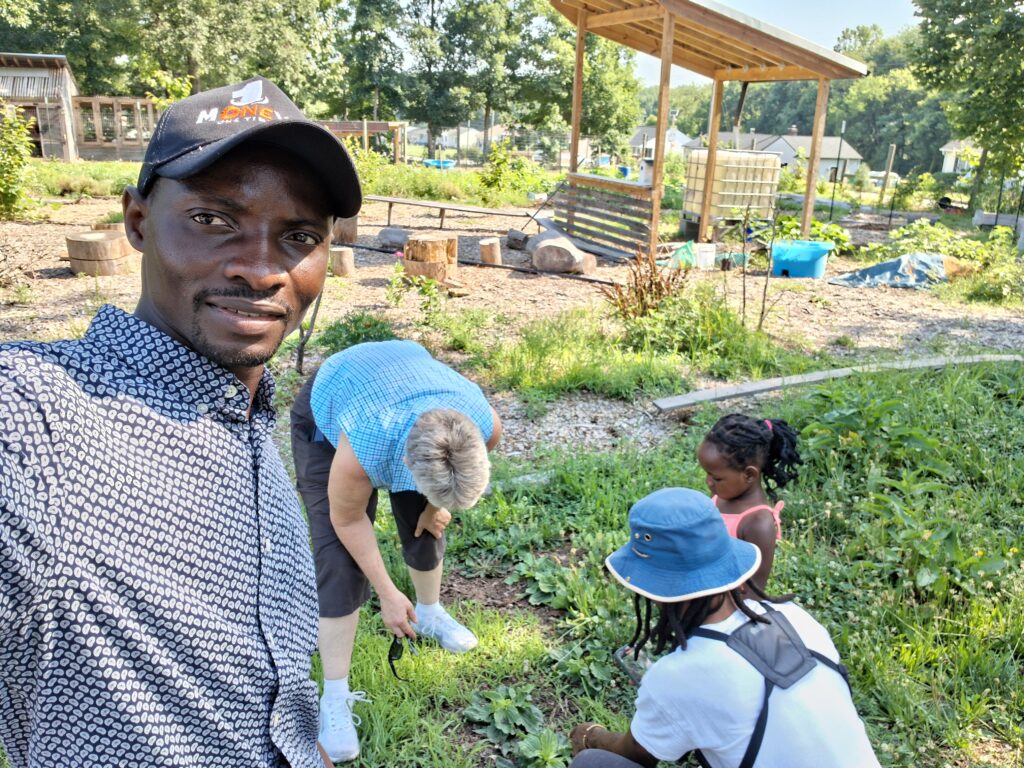
When people think about seminary contextual education, working on a farm might not spring immediately to mind. But that’s exactly how Simbarashe Ndowa spent his last summer—working with Rev. Callie Walker and the Agrarian Trust on a project that seeks to transfer land ownership to farmers of color and provide agricultural training.
As Ndowa works to complete his Master of Arts in Public Ministry degree, Callie’s Farm was a natural fit. “I was attracted to the program because I wanted to see how the church can be involved to promote social justice programs,” he says. “At Africa University in Zimbabwe, I studied environmental science. I’m very interested in how we can bring back indigenous knowledge systems and farming practices, using organic instead of synthetic chemicals, to help transform rural communities in Africa.” On the farm, he had the opportunity to get his hands dirty—literally—but also to deeply consider the underlying racial and economic systems, and where the Spirit is moving for a more just world.
Rev. Callie Walker is a United Methodist elder, but she is also the daughter of a Virginian farmer who left her hundreds of acres as an inheritance. In this gift, she saw an opportunity to make her own reparations in a country where 80% of farmworkers are people of color but only own 2% of all farmland. Working with her gave Ndowa a unique window into the ongoing work that Agrarian Trust is organizing on the land she used to own.
“I was involved in farming and gardening lessons for a constellation of farmers—most of them Black. We had both a high tunnel and an open garden where we grew a variety of crops. My responsibilities were mainly taking care of the garden,” he laughs. “But each week I also visited a different church to preach, reflecting on my journey from Zimbabwe, and how I imagine ministry can take part in ecological regeneration.”
In his youth, Ndowa witnessed significant harm in rural Zimbabwe that mirrors struggles folks experience here in the United States. “When colonization came to Zimbabwe, we were forced by government policy to leave our traditional practices. We were made to do commercial farming instead of producing crops for food,” he explains. “Now, people experience widespread poverty and food insecurity, because what we are producing we cannot consume, we grow it for the market.”
When he preached for local churches, Ndowa sought to offer hope that this kind of extractive relationship with land and people does not need to be the end of that story. “If the gospel cannot be relevant to an African person in our particularities, then it fails to be the gospel of Jesus,” he says. “Our government has failed us. But we can think creatively, instead of asking them to provide systems and infrastructure. We can create our own infrastructure that will raise the standard of living for people in rural villages.”
This is a particularly crucial concern as the African continent experiences widespread and devastating effects of climate change. “I came to Garrett wanting to focus on working with youth in our communities. Then, I realized that this naturally folds into how communities can be empowered in the face of environmental degradation and climate collapse,” he says. “I realized I can focus on the exploitation of children and other vulnerable groups in marginalized communities to provide solid, practical solutions that can help provide food, improve health, and repair our environment.”
It’s a very different theological approach than the one he has often seen in churches. “I used to be part of a Pentecostal denomination, where we mainly focused on preaching and teaching people the Bible, instead of centering our ministry on the serious issues affecting their lives,” he says. “My hope is to go back to my village and help my people emancipate themselves against the powers and political systems that create widespread poverty and food deserts—a church that goes far beyond preaching to people from the pulpit.”