

From Extraction to Reciprocity
December 17, 2025
Nurturing decolonial partnership in Chile
Wendy Cordero Rugama
For centuries, Christian institutions in the United States initiated and sustained paternalistic relationships with Latin American communities that perpetuated colonial harm. In church contexts, these relationships might take the form of missionary trips where a group from the United States visits a community in Latin America to do something for them. This often involves a construction or renovation, a large investment that could have paid local workers instead. In the academy, these paternalistic relationships hinge on the notion that ideas coming from a U.S. context are universal and applicable to Latin America, while the ideas emerging from Latin America are only relevant in their context. As Garrett Seminary begins a new partnership with the Methodist Church in Chile, our collaboration is shaped by deep awareness of these dynamics’ history and repercussions, and a commitment to their dismantling.
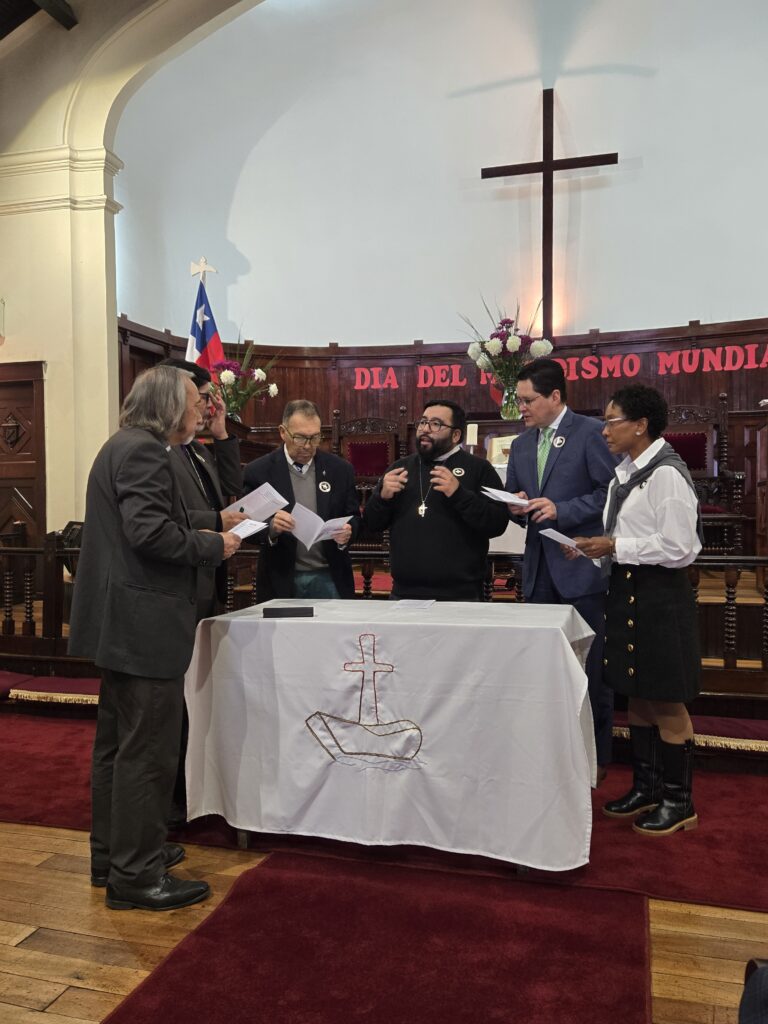
In the Spring of 2025, Garrett inaugurated this partnership with a visit from Rev. Miguel Ulloa, director of the Methodist Seminary of Chile, who taught at Garrett’s Escuela de Ministerio, training pastors and lay leaders across the United Methodist North Central Jurisdiction. A few weeks later, a delegation from Garrett traveled to Chile to learn about the Methodist Church and its seminary’s work throughout the country. Dr. Emma Escobar, Director of Centro Raices Latinas at Garrett, describes this partnership as a project built on reciprocity and a model for the relationships the Centro Raices seeks to cultivate across the region. Both Rev. Miguel’s visit to Garrett and Garrett’s delegation to Chile disrupted the dominant dynamic that would frame Garrett as teacher and the Chilean church as student, denying the possibility of reciprocal learning and mutual enrichment. “As Methodists, we have a common language of theology and tradition that unites us and gives us an opportunity to expand what the dialogue between North and South America can look like,” reflects Rev. Miguel Ulloa. “Despite the differences of our contexts, we have shared concerns, and this dialogue allows us to learn from one another’s responses to those issues.”
The Methodist Church in Chile was founded by North American missionaries almost 150 years ago. Following the Wesleyan teachings of personal piety and social holiness, the church developed vibrant education, social care, and healthcare ministries. During their time in Chile, the Garrett delegation witnessed these ministries at work through visits to schools and clinics across the country. Reflecting on what she learned while visiting English immersion schools in the north of Chile, Dr. Escobar highlighted the way these schools contextualize their curriculum including, for example, an effort to begin teaching indigenous languages as part of the Chilean government’s project to reclaim Chilean indigeneity.
This conversation about indigeneity and Indigenous rights is one of the concerns that the Methodist Church in Chile and Garrett share. In the last few years, Chile has made important progress in advancing Indigenous rights, yet Rev. Ulloa believes that the church in Chile still has significant work to do in this area. He hopes that partnership with Garrett’s Center for Ecological Regeneration can help Methodist leaders in Chile access resources that will help them raise consciousness in congregations about Indigenous Chileans’ lived realities and Christianity’s historical complicity in their oppression.
As this partnership continues to develop and grow, both Garrett and the seminary in Chile will have opportunities to welcome students and faculty from each institution. In the near future, Garrett students will be able to complete their field education in Chile, and Chilean faculty will continue to support the Spanish-language programming at Garrett. “The ministry and programming of the Methodist Church in Chile will be a great resource for U.S. students and ministry leaders. We have much to learn from our Chilean siblings’ impactful and creative work,” comments Dr. Escobar. Likewise, Rev. Miguel says that “Chile has theological and ministerial riches that have not received the attention they deserve from the academy and the global church.” By welcoming students from Chile into our masters and doctoral programs, Garrett will be a resource for Chilean theologians and practitioners to disseminate their scholarship. These educational exchanges will strengthen the work each seminary is already doing and will nurture collaboration between scholars and practitioners from both institutions.
Dr. Escobar notes that as a U.S.-based institution, Garrett enters this partnership aware of the colonial impulse that has often guided relationships between institutions in the U.S. and the Global South. She reminds us that, “Chile has developed ministries with very few resources, and unlike what typically happens in the U.S., their conversations don’t start with questions about money or profit, but with a commitment to the mission. As we learn from their work, we must remember our responsibility for how we live in a capitalist world, and how our actions here in the U.S. affect people’s lives globally.” Dr. Escobar adds, “Ultimately, when we learn from the work the Methodist Church in Chile has done, we are not glorifying their struggles, but we are learning what it looks like to live out the mission in a way that uplifts the people and their needs above all else.”