

Seeing God in Your Neighbor
April 27, 2026
Luke Miltz answers a call to interreligious engagement
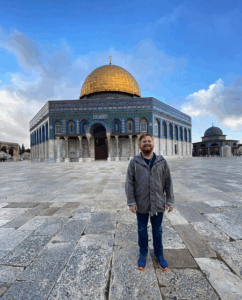
“The purpose of the church isn’t to surround ourselves with other Christians.” It’s a provocative sentiment, but one that centers Luke Miltz’s call as he prepares to graduate in May. A Master of Divinity/Master of Theological Studies dual-degree student, Miltz has focused his coursework and thesis on how Christians can better participate in interreligious engagement. Part of his conviction is that the United Methodist Church and other denominational bodies should devote less energy to institutional self-preservation and will find revitalizing energy in collaborating with folks outside the church.
In his thesis, Miltz focuses on how the belief that all people are made in God’s image should shape how Christians interact with neighbors from different religious traditions. “In many of the Christian circles where I grew up, there is a palpable anxiety about who is saved and who is not,” he notes. “Folks get so passionate about the ‘saved’ part but lack that same passion for that indwelling divinity. Being a good neighbor isn’t about checking on the other person’s salvation; it’s about honoring the way they also reflect God.” Sometimes, this looks like moving away from philosophical or existential concerns, instead devoting energy to a fundamental neighborliness. “Congratulate people on their wedding!” Miltz continues. “Be sensitive if someone you know is sitting Shiva or observing Ramadan. As United Methodists, we have resolutions in our doctrine that encourage us to hold non-Christian beliefs in the highest esteem we can.”
During his time at Garrett Seminary, Miltz has had the opportunity to intern three years for the United Methodist Council of Bishops, helping to create tools to deepen people’s understanding for ecumenism and interreligious encounter. “I’ve been interviewing people across a wide range of religious perspectives, creating written and video content,” he says. “It’s called Neighbors in Common, and we’re trying to help Christians understand that interreligious engagement really comes down to loving your neighbor well. I want to equip people with the language to honor differences—in a way that neither person has to be ‘right;’ instead we’re both present and open.”
In a moment of ascendant Christian Nationalism, living under a government that has framed ongoing military conflict in explicitly Christian language, the exhortation to be a better neighbor feels both essential and profoundly counter-cultural. “I have grown up in a post-9/11 America where Islamophobia was very much part of the linguistic and cultural fabric,” he notes. “I’m only 31, and I didn’t expect to see another war coming in the Middle East—that I would hear the same language about fighting for Christian values. It’s so similar, twenty years later— this work, sadly, feels deeply relevant.”
As Miltz prepares to serve after graduation, part of what he hopes to offer Christians is a willingness to lean into discomfort, as they learn new theological frames that better facilitate connection across difference. “It’s something I know deeply as a queer person who grew up inside the church, so impacted by the work of God and the teachings of Jesus in my life,” he explains. “Creating space for myself in the church has required both myself and other people to lean into that productive discomfort. If we can do that for queer people in church spaces, we should be able to do that for people of other faith traditions or no faith tradition.” One teaching he finds helpful is an exhortation by Sikh author and activist Valarie Kaur. “She talks a lot about opening yourself to wonder,” Miltz notes. “I’m not trying to push people to be uncomfortable for its own sake, I want to encourage curiosity and help them nurture dialogue with other ways of thinking and living.”
Like many graduates, Miltz plans to begin this work bivocationally, pairing this burgeoning work with his job in healthcare marketing. “I’m glad I don’t feel pressure to immediately get a job, but I do feel pressure to answer this call to ministry,” he explains. “Part of what I’d like to do eventually is carry this corporate experience over into non-profit leadership.” In a dream future, he’d love to serve an organization like Interfaith America, engaging this mission for harmonious interbelonging on a national scale. But he’s not going to wait to start engaging the public. “I’m so grateful for the academic flexibility Garrett offers. Part of why I’m extending my thesis out over a year and a half is that I want to start a YouTube channel where I articulate what I’ve learned in short- and long-form videos,” he says. “I think that’s a medium where people are really engaging. Everyone has a spiritual life, even if they may not call it that. I want to build connections with them, making community that creates space for something new.”