

Feminisms, With an “S”
April 22, 2026
By Allie Lundblad
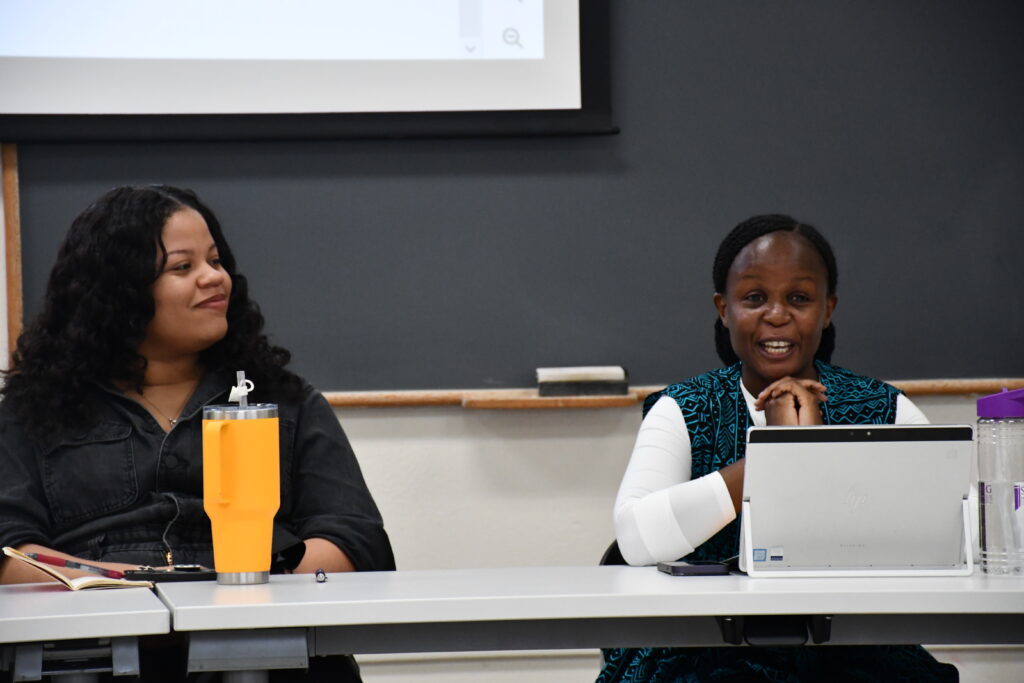
Dr. Anne Joh knows it is a bad word to some, but she loves it. “I love that word, and I love the movement and concept,” she says.
That word —feminism — was the topic of conversation at the March Let’s Talk Globally lunch, featuring a special Women’s History Month panel. PhD students Candace Simpson and Jacklyne Atotso each spoke on the contexts, experiences and intellectual traditions that shape their feminism, its intersections with their academic work, and the interplay between feminism and religion. Together, they embodied a reality Dr. Joh named as she moderated the conversation: that “feminism” and “feminist theology” are terms that should always be used with an “s.”
“Feminism is not monolithic,” she said. “In global women’s movements of resistance, feminism is understood in the plural, as in feminisms. We understand that feminist movements have shared commitments but they are also movements grounded in lived realities that are often also not singular or monolithic.”
Atotso, for example, describes her own feminism as “deeply African, community-rooted, and faith shaped,” going on to explain that “it begins with the stories that honor the humanity of an African and the stories that women tell about liberation and about injustice. For me, feminism is not about competing with men or fighting the culture. It’s about restoring that dignity, that God-given humanity to women as well as healing that which is broken within my African culture.”
In her home country of Kenya, Atotso says, it is far too often the case that the vital contributions of women go unnoticed, young women are “pushed out of school because of early marriage or poverty,” and violence against women is ignored. All of this is propped up by patriarchal theologies and biblical interpretation that emphasizes the duty of women to submit. Yet, within the movement against gender-based violence, there are churches that support survivors and advocate for women. Atotso also recognizes a “long history” of women in religious and community leadership, theology and ethics.
“This tells me that feminism in my own context is something that has been there,” she says. “It’s not something that was imported, and so my feminism honors those strengths of my culture and it challenges that which denies the flourishing of women and the community at large.”
Simpson, on the other hand, considers herself to be “a Combahee River Collective feminist, meaning I draw my inspiration and I take my marching orders from the Black lesbians and feminists who were socialists meeting in the ‘70s,” she explains. “They came together to think through what feminism meant for them. These women met for three years before they produced what became the Combahee River Collective Statement.” That document, grounded in the dialogue that comes from sharing life together, gave voice to the realities of intersecting identities and interlocking oppressions. Not only did these women take the time to develop their ideas, but “they had such incredible style,” Simpson adds. “They were just badass women from head to toe, which I aspire to be.”
In today’s world, that means struggling against anything that reduces identity to labels, limits choices and denies embodied experience. Simpson described her anger over the “evil we are witnessing, the violence, the chaos” created in the name of Christianity and the United States, but also her frustration at the cultural pressures that restrict thoughtful critique and the imagination of other possibilities, like a third, viable political candidate. “I think that hoping for a third way is a deeply feminist hope, and it is the hope that keeps me alive when I’m looking at option A and option B,” she said.
At the same time, Simpson recognizes the cost to those—like preacher Prathia Hall and writer James Baldwin, both civil rights leaders—who refuse to be reduced or to fall in line, noting that “there are always consequences for being the wrong kind of token,” even in the church. “It wears on our bodies,” she said. “There’s no amount of bath bombs that I can purchase that would counteract the fact that I do not have enough dollars, and not having enough dollars is basically y’all telling me you want me dead in capitalism. Those are feminist issues to me.”
Dr. Joh, who shared some of her own thoughts as she facilitated the panel, describes her feminism as intersectional and transnational, connected to women and their communities around the world. As a scholar, she has been influenced by theologians of Asian descent—Rita Nakashima Brock’s Journeys by Heart convinced her not to leave seminary for law school—as well as mujerista and womanist theologies. She has been supported by an interfaith and inter-generational network of peer-mentors, the Pacific, Asian, and North American Women in Theology and Ministry. And she has been “inspired by the women in the church, in particular Korean women.”
“You know, in the United States, I grew up with the racial stereotype that Asian women were submissive and quiet,” she says. “I thought, where are these submissive and quiet women? Because the Korean women I know are really strong women. When I write, I think of my mother foremost as a church woman, the strength that she embodied and her hermeneutics of suspicion.”
For Dr. Joh, one of the major tasks of feminism is to interrogate the performance of gender and how it fits into larger systems of violence and oppression. Referring back to the quote from feminist scholar Chandra Talpade Mohanty she’d used to begin the panel, Dr. Joh described her work inside and outside of the classroom as an effort to “unsettle existing power structures” and bring something new into being.
“How do we as feminist theologians think of insurgency?,” she asked, in closing. “Be part of that insurgent movement towards different kinds of futures for ourselves, and not just for women. This is for everyone’s humanity, everyone’s dignity.”