

Streaming a Joyful Noise to the Lord
October 15, 2025
By Benjamin Perry
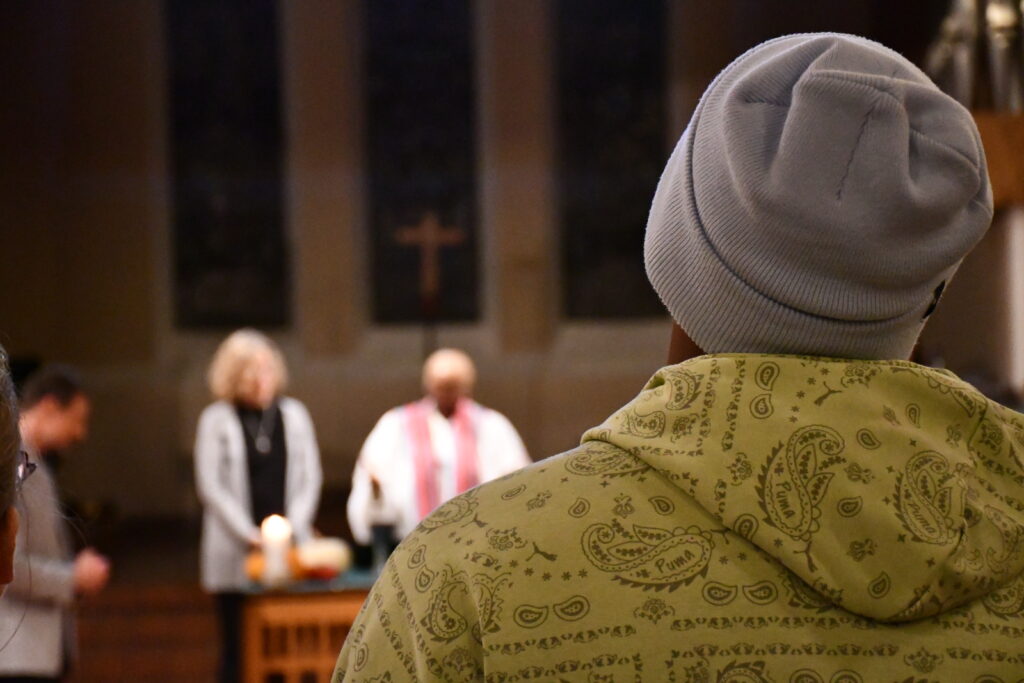
Every worship is the product of collective vision, a blend of the liturgical, theological and aesthetic styles among the team that births it. At Garrett, this offers a unique chance for international and domestic students to work side-by-side, learning from one another to craft experiences that will move the diverse communities who call Garrett home. Worship staff meetings become a laboratory for this mission, a place to explore how we can synthesize traditions—melding more Eurocentric United Methodist worship with influences from charismatic African praise bands to cultural offerings from India, East Asia or Latin America—into a holistic moment for Spirit to flow.
This calling is reflected in the relationship between chapel coordinator Janson Steffan and Olivier Sundika, who operates the video cameras and produces the online stream that off-campus worshipers access. For two years now, the pair has collaborated on planning and recording worship in ways that provide a dynamic experience for both the people in the room and all who gather online—a formidable task, as any worship leader will tell you. “It’s more than just a technical thing, it’s more than artistry,” Steffan explains. “It’s creating a way for people who are online to feel like they are connected and participating in worship.” That calling is made doubly challenging when you consider the fact that, when he joined the worship team, Sundika had no experience managing a livestream. “Janson is the one who taught me to do it,” Sundika laughs. “The first day he came with me, explaining the cameras and sound system, and I was just tripping out, like ‘What have I gotten myself into?’ But as I followed him every day, chatting and talking, I learned so much—and not only technical skills.”
Indeed, Steffan reports that Sundika quickly moved beyond rudimentary competencies to become an active collaborator in the livestream’s artistic vision. “He understands his role so well. He’s looking for good angles for the altar, actively switching cameras to make sure he’s following the way the person is facing,” Steffan explains. “When the presider is offering communion, he creates an intimacy setting up the shot—so it’s not a wide angle that makes the pastor look tiny but keeps enough breadth so you can see the cup and the bread, invited into the moment through the pastor’s hands.” After worship, Olivier often lingers to analyze the recording and think through ways to improve the next week’s offering. “He and I easily fell into conversations, adding a voice from a completely different context to discuss how we can offer moments for the Holy Spirit to work,” Steffan recalls.
Through these deeper conversations, Sundika shares that he’s developing voice and vision for how Garrett’s worship can reflect international students’ liturgical contexts, like his own experiences growing up in the Democratic Republic of Congo. “The worship style in Africa is so vibrant, with people dancing and playing traditional instruments like the drums,” he says. “When I’m talking with Janson, I’m always thinking about how we can weave in details to be inclusive of those traditions. Even if it’s just a small verse we read in Chinese, Korean, or Hindi, it has meaning to acknowledge the students in our community.” The inclusion of these elements also offers students a variety of worship forms they can use to serve the congregations they will one day lead.
Through the combination of technical skill sharing and theological reflection, the team has created something that transcends mere working partnership. “We come from so many international contexts, such different cultures, but we’ve made a deliberate effort to engage with and nurture one another,” Sundika says. “It’s more than just friends now, it’s almost a family with the team we are making.” And that empathic exchange is reflected in what the community experiences each Wednesday. “There’s a flow to things, whether that’s understanding how the different worship elements relate to one another or how our team works together,” Steffan concludes. “It’s such a good feeling to know that I can trust Olivier, that I don’t have to worry about anything. I can just do what I’m supposed to, coordinating the service, the music, and the liturgy.”