

Shouldering the Family Stole
October 17, 2025
By Benjamin Perry
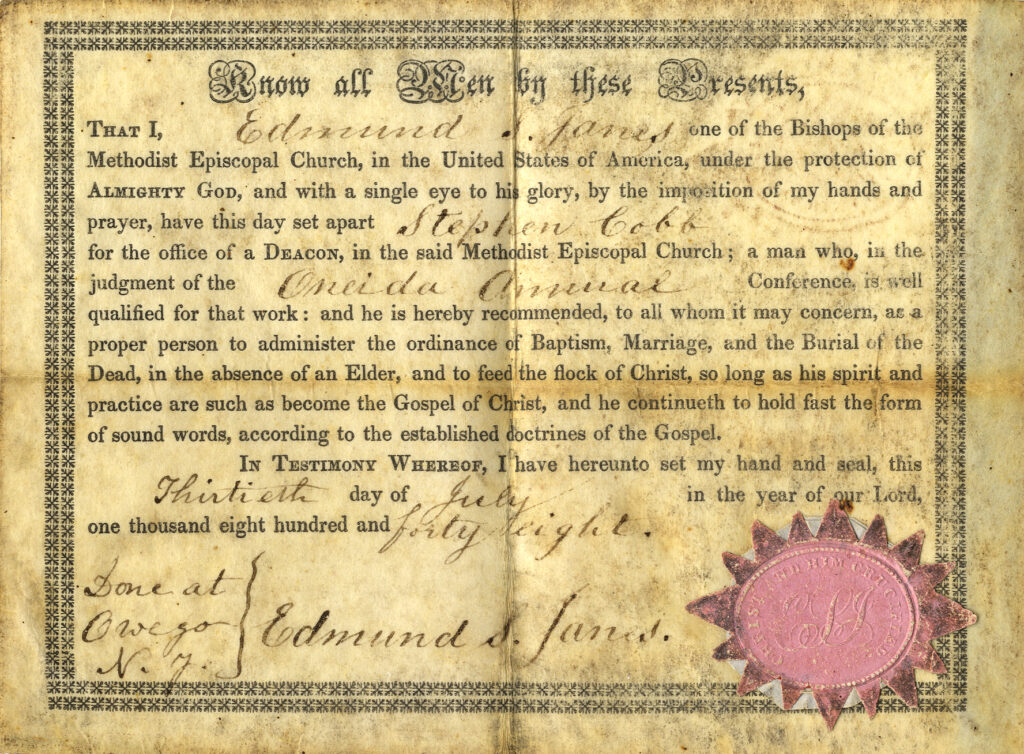
Dr. Daniel Cobb holds his great-great-grandfather’s diary at arm’s length, pages crinkled yellow with age but florid script still plainly visible. Cleanly printed on the top of the page is the date: January 1, 1878. Inside Rev. William Cobb recounts his days traveling and preaching the Word in Upstate New York as an elder in the Methodist Episcopal Church—the United Methodist Church wouldn’t be born for nearly another century. It’s a stunning inheritance: The contemporary Dr. Cobb traces his lineage across five consecutive generations of Methodist ministers. After a long and thriving career in academia, he is ready to join them.
“When the call came this time, I just couldn’t refuse it,” Dr. Cobb confesses. “It’s counterintuitive—I am a full professor, I’ve done lots of publishing, I have secured my place in my field, and yet this suddenly felt like the right moment.” It’s certainly not the first time he’s heard God’s whisper drawing him toward ministry. He considered enrolling in seminary when he finished his undergraduate program at Messiah College but instead chose to pursue an M.A. and Ph.D. in History, specializing in Native America. In a noteworthy academic career, he served as assistant director of The Newberry Library’s D’Arcy McNickle Center for American Indian and Indigenous Studies in Chicago, then taught for more than twenty years at Miami University of Ohio and the University of North Carolina at Chapel Hill. Despite professional accolades like winning the inaugural Labriola Center American Indian National Book Award, being named the Fulbright Bicentennial Distinguished Chair in North American Studies at the University of Helsinki, and creating the Great Courses on Native Peoples of North America in partnership with The Teaching Company and the Smithsonian’s National Museum of the American Indian, he couldn’t shake the feeling that he was drawn toward a different path. “The meaning that I used to make in my life through teaching, research, and service just was not fulfilling me,” he says. “Simultaneously I looked at what’s happening in the Church and thought, ‘This is a fight that’s too important not to win.’”
So, Dr. Cobb finally yielded to the voice that had drawn him toward ministry for decades, sold his house, held an estate sale, and enrolled in the institution that educated his father. In some ways it’s a dramatic, life-altering choice, but in others he sees it as a continuation of motivations that have long fueled him. “I’ve always felt a deep passion for teaching and serving, to be what Reverend Justin Coleman calls “an architect of community,” he notes. “That’s what gives us meaning and purpose. We don’t exist as solitary beings, we can only exist in relationship to and with others, and those relationships matter.”
From the moment he arrived on Garrett’s campus, he felt at peace with his choice. “It’s so energizing to be at a place where you’re surrounded by people who clearly share those values and can help me understand them in ways I’m just beginning to think about,” he reports with joy. “Garrett is special in the seriousness with which it considers formation and discernment. I expect I will be ordained, but I’m so curious where that road will take me.”
Dr. Cobb’s unique background offers myriad possibilities to blend his academic work with his future ministry. He’s already been appointed by Dr. Timothy Eberhart as a Center for Ecological Regeneration Scholar. In that capacity, he’ll work closely with Garrett’s ongoing Indigenous Study Committee as they prepare a report on Garrett’s historical, theological, and institutional relationship with Midwest Native peoples and recommend reparative actions. That work to push United Methodist institutions to be accountable for harm, however, extends well beyond Garrett. “I was already very much interested in matters of truth, reconciliation, and repair as a scholar of Native America,” he says. “I’m excited how being at Garrett will give me an opportunity to do that work in new and meaningful ways.”
Dr. Cobb’s passion isn’t just intellectual, it’s personal; deeply intertwined with how he understands his family’s own history. “I do know how deeply my father is committed to the Social Gospel, but I don’t know how my ancestors thought about the relationship between economic or racial justice and the church. These histories can get complicated very quickly,” he observes. “I’ve never had the time or space to investigate those family legacies in depth, and I am terribly excited to make coming to a fuller understanding of my inheritance a part of my journey.” Wherever that path leads, it offers the chance to engage the past and labor for present healing in a country that badly needs to travel that same road. “I’m not willing to give up on the role that Christians and Christianity can play in creating a better world,” he offers with conviction. “It is not just that the church can do good work and undo the damage that people and institutions have done in the name of Christ. It’s that it must.”