

Rest for the Weary
June 4, 2026
A queer clergy retreat offers space for joy, prayer, and community
By Rev. Benjamin Perry
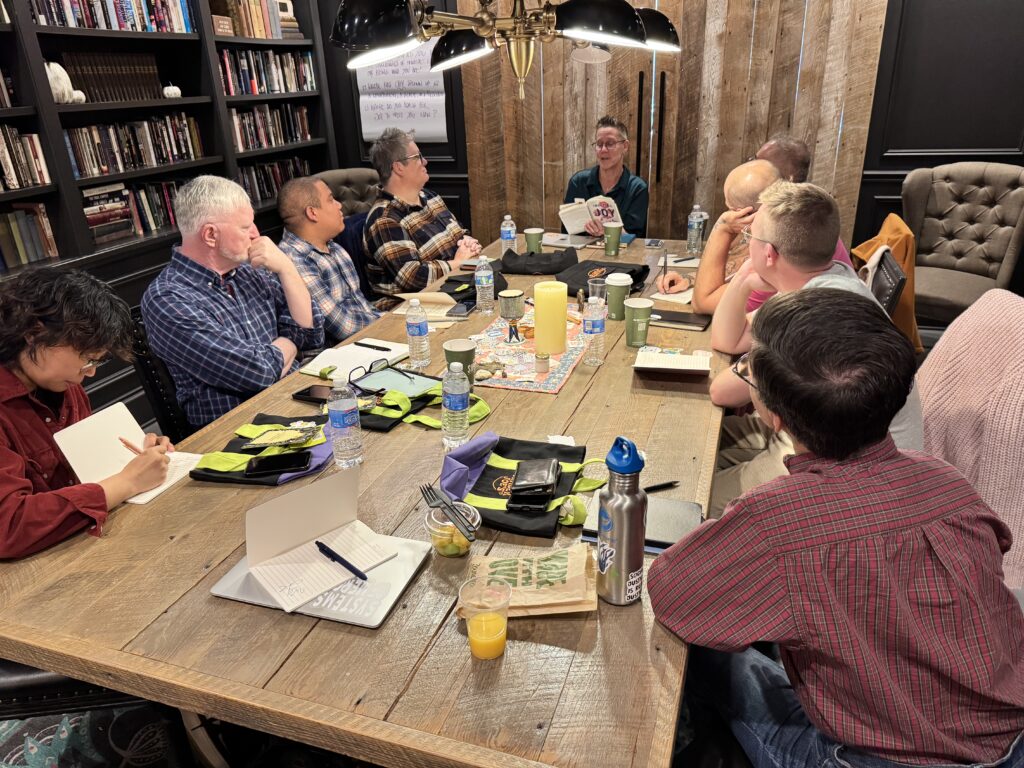
Queer clergy are tired. Obviously, that’s a blanket statement and there will be exceptions, but it’s true for nearly every LGBTQIA+ clergyperson I know as well as for my own weary bones. While some of this stems from the widespread burnout afflicting ministers of every gender and sexual orientation, there are factors that put queer pastors at particular risk. We are more likely to work in a lower-paying call, we face denominational hurdles and complications that outstrip our cishetero peers, and we are often intimately interwoven with wider LGBTQIA+ circles—who face disproportionate discrimination, violence, and death. As if that weren’t enough, many states and the federal government are now engaged in well-funded campaigns to restrict our rights and freedoms, and to remove what legal safeguards still remain. We. Are. Exhausted. And it’s why I couldn’t be more grateful for this year’s queer clergy retreat, offered by Dr. Rolf Nolasco and Garrett’s Rueben P. Job Institute for Spiritual Formation, funded by the Carpenter Foundation.
I want to offer a little more context for this reflection, because it helps explain the depth of my gratitude. In addition to working part-time as Garrett’s Director of Communications, I’m also a Presbyterian minister who brings queer theology workshops to rural congregations in Maine, and who serves on the board of OUTMaine—our state’s largest service provider for LGBTQIA+ young people. It’s work I love deeply: Every year, I get to watch hundreds of young people glow with joy at our Rainbow Ball, an alternate prom for queer high school students. Their enthusiasm is palpable and infectious: Some of them are the only openly out kids at small, rural schools, but on that dance floor they get to live abundantly as themselves and experience the freedom that God yearns for them to know. All year, the organization offers incredible, lifesaving programs, but since 2024 we’ve been forced to spend incalculable time and energy fighting against legislative cruelty.
The federal administration canceled hundreds of thousands of dollars in grants we were intended to receive, creating a significant hole in our budget. If that wasn’t bad enough, a billionaire from Illinois spent $800,000 paying people to collect signatures in an attempt to put virulent anti-trans legislation targeting our state’s children on the fall ballot. So much time, attention, and resources have been spent fighting these developments—energy that takes us away from the work to which we all feel called.
This fall I found myself feeling overwhelmed by the enormity of the obstacles that face us, when an email hit my inbox like the Holy Spirit descending through the clouds. Would I like to join The He(ART) of Queer Joy, a retreat with Chicagoland LGBTQIA+ clergy? At a swanky Andersonville hotel? Fully funded? I’m surprised I didn’t break a key in my haste to reply yes.
A few weeks later I found myself gathered around a table with new colleagues who I did not know, but who shared both my passion for this ministry and my lamentation in our present moment. In a sacred circle, we talked with Dr. Nolasco and one another about how joy can be a resource that sustains our ministries. We got to learn from Dean Jennifer Harvey how to deepen the ways we embody it. Ph.D. Student August Venuh guided us through a painting exercise designed to tap into our intuitive understanding. But more than just what we learned, we received the gift of one another’s presence. We shared delicious and nourishing meals. I learned about how Chicagoland clergy were resisting ICE, right as those same networks were becoming necessary here in Maine. I heard from pastors who came out late in their careers, got to offer wisdom and guidance from my own experiences. I felt my shoulders ease in the comfort of a room where I did not need to worry about how much I revealed about who I am.
I can’t tell you how healing it was to receive this kind of treatment from a religious institution. As queer clergy, we become used to being treated as an afterthought—when we’re considered at all. We settle for what resources we can wring from the rocks, stretching dollars and doing more with less. We smile and persevere when our work is overlooked by denominational bodies and budgets. Dr. Nolasco turned those conditions on their head. In the hands of this retreat, I felt centered, I felt valued, I felt beautiful. I heard affirmations for the work we’re doing in Maine, celebration for the ways it extends God’s love. Like a hungry desert plant, I took that water deep into my roots, storing it away for the work I knew lay ahead even as I reveled and spread my leaves in gratitude.
At our closing circle, I heard my experience echoed by others around the circle—how they, too, were grateful for space where they could live fully without reservation. A space where they could express the religious dimensions of our queerness that sometimes feel awkward in wider LGTBQIA+ community, so filled as it is with people recovering from religious trauma. And for the many folks who worked multi-vocationally like myself, just a space to stop, breathe, and be offers healing beyond measure.
When I returned to Maine, I found myself enervated by the experience, renewed in my joy for this ministry I love. As the internal burdens lifted, it seemed the external ones became lighter. Everyday people from around the state came forward to donate to OUTMaine, making up a sizable portion of the funding we lost. Instead of reducing our programs for youth in the state, we expanded them. We joined a coalition of organizations who mounted a legal challenge against the proposed anti-trans bill—thousands of whose signatures were gathered illegally—and, last month, received the news for which we prayed: Maine’s secretary of state struck it from the ballot. One retreat doesn’t fix everything: I am still tired, in ways I’m sure the other participants no doubt share. But the joy from that weekend remains a private well of gladness from which I can draw, a palace carved from time and fellowship where I knew without a doubt I belong. It’s the kind of gift that keeps me moving forward, following Jesus to bring God’s love to the places its needed most.
This retreat is part of a series organized by the Rueben P. Job Institute for Spiritual Formation, funded by the Carpenter Foundation. Future retreats will offer restorative space for clergy of color, women clergy, and more. Contact Dr. Rolf Nolasco for more information.