

Nurturing Ministries of Compassion
April 14, 2026
Dr. Michael K. Washington wants to help students follow God into the caring encounter
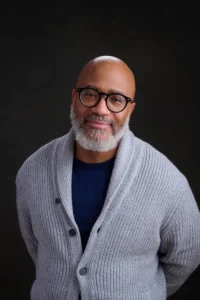
Never forget that providing care is a form of ministry. That’s a core conviction for the Reverend Dr. Michael K. Washington, who will serve as Garrett Seminary’s Assistant Professor of Pastoral Theology and Chaplaincy Studies. “Chaplaincy and congregational leadership have been my primary calling,” he names with pride. “I want to bring those lanes and lines of awareness to support students in their ministry, while also providing pedagogical experiences that honor everyone’s lives and offer ways to do care in many spaces and spheres.” But while students may enter a variety of vocations, in the past four years he has taught the Foundations and Practice of Chaplaincy course at Garrett they frequently express gratitude for the way Dr. Washington situates care and counseling as a form of pastoral formation.
Part of this approach reflects Dr. Washington’s own journey into chaplaincy. He has served as a chaplain and ACPE supervisor at Northwestern Memorial Hospital since 2017, but before that role he was the Associate Pastor at Chicago’s New Community Covenant Church for more than a decade. “In pastoral theology, everyone has a bent and a practice. My practice comes out of the congregation, through the hospital,” he explains. “I am formed by the communities who shaped me, the spaces where I did the work.”
Those formative spaces also include Garrett, where Dr. Washington received both his MDiv in 2005 and his PhD in 2024, and he sees entering a new role at the seminary as an opportunity to pay forward wisdom that others invested in him. “When I enter the classroom, I’m bringing the teachers who trained and informed me,” he says. “I want to bring and represent them well, as I encourage students to reflect on who they bring into that space. We are never coming alone.” This communal disposition also fundamentally shapes his approach to care. “In a culture that can be hyper-focused on individuality, we must remember that care is a collective and communal practice,” he notes. “God is granting Garrett the gift of students who have been shaped by communities all across the world, offering us a chance to engage in mutual learning. That’s the kind of opportunity that gets you up in the morning.”
When asked what grounds this orientation, Dr. Washington is quick to point to experiences within the Black Church. “I do draw upon Black life and thought, which tend to be community oriented,” he explains. “I grew up in congregations where we learned and sung Scripture, memorizing the words of God, as a way of rehearsing care. But those traditions came from a ground and soil that weren’t exclusively Christian, so there’s also a historical consciousness for the me that’s in the mix—an ancestral legacy for Black folks that found articulation in that scriptural language.”
One lesson Dr. Washington hopes to share is how the practices which characterize effective ministry are also crucial to providing compassionate care. “I’m always asking students to be mindful of three things in spiritual care: Always be listening, always be praying, and always be assessing,” he says. “When students listen well, that will always be a good marker for care. When they pray and inquire how the other person understands God and the sacred in that moment, it helps the person feel seen. And then you combine that with asking, ‘What’s happening in this? What’s your next intervention because of what’shappening.’” These skills offer students concrete practices to hone as they enter their vocational fields, helping to build confidence and develop their caring muscles until those habits become instinctive.
Though his own path led from the parish through the hospital, Dr. Washington believes these practices will help students wherever they serve. “I don’t know where students will ultimately choose to practice care,” he notes. “They may be on staff in government. They may work for a nonprofit. They may be doing ministry in jail. So, I want to offer skills that are applicable to a wide assortment of spaces and places.” Once students become adept at working with these tools, they can become better conduits for the healing work that God enacts through relationship. “In my MDiv work, Dr. Bedford would talk about how you know good theology because it can be preached,” he muses. “But it’s also true that good theology can be sung, and there’s a musicality to care when the Spirit is moving—the ways that Jesus calls forth new life.” At whatever point in their journeys that students enter Garrett, helping them listen for that holy music is work that brings Dr. Washington joy. “I love watching people grow in their capacity for care,” he says simply. “However good you are at your beginnings, you’ll get better the longer you go.”