

Engaging the Bible with a Fresh Heart
April 14, 2026
Why Dr. Angela N. Parker invites students to invest deeply in biblical interpretation
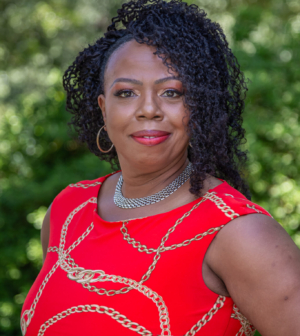
“Have I been trained to read as a White male scholar?” It’s a question that vibrantly burns through the Reverend Dr. Angela N. Parker’s scholarship, but also one she wants students to critically ask themselves as she prepares to join the Garrett Seminary biblical studies department as Associate Professor of New Testament and Womanist Thought. “Paying attention to how Christian commentaries equate Christianity with Whiteness to uphold dominance has to be part of our conversation in an age when Christian nationalism is on the rise, when Islamophobia and Antisemitism are running rampant,” she explains. “It’s critically important, not just for African American and womanist interpretations, but for Asian, Latine or African interpretations—and so White students can see the biblical text more fully, instead of through a veneer of Whiteness.”
As she enters a new theological institution, Dr. Parker brings a host of awards and accolades which testify to her ability to re-engage the Bible and its ancient audiences free from stifling interpretations that can blinker our understanding. Her 2021 book, God Still Breathes, Why Can’t I? Black Lives Matter & Biblical Authority garnered widespread praise for the clarity with which she portrays the ways she was trained to forsake her own embodied identity and assume a White gaze when reading the biblical texts. Now, she is ready to build on that foundation and expand the field of biblical scholarship. “The Reverend Dr. Cheryl Anderson was a good friend and treasured mentor to me for years—the fact that she was able to have such a successful career and then retire from Garrett made it seem like a perfect place for me to enter into my own senior status as a mid-level, mid-career womanist New Testament Scholar,” she says, joy writ large across her smile. “When I came on campus, the diversity and excitement of the student body made my choice an easy decision. I thrive in scholarship, and I thrive on teaching in the classroom, and I am so excited to take all of that and add to the womanist canon, particularly in Pauline literature.”
It’s an intentional choice, as Paul has long been treated as a bastion for the kind of scholarship which props up White Christian nationalism—a favored well from which to proof-text. “My favorite text to use to help students see Paul in a different way is Galatians, to think about Paul addressing the Galatian people and the Galatian people’s own history,” she explains. “The Galatian people are a subjugated people, who understood themselves as ‘better off dead’ according to the Roman Empire—part of the reason that they are trying to take on circumcision, eat kosher, and follow Jewish holidays is to overcome what I would call an inferiority complex because the Roman Empire has been telling them that they are inferior.”
What does it look like, then, to let that historical reality inform the way we understand the exchange between Paul’s letter and Galatian self-understanding? “To reframe Galatians, we must take seriously how the Galatian people are hearing this text,” Dr. Parker says. “What does it mean for Paul to use the language of motherhood and birthing even though he’s never had that bodily experience of bearing down? You have to remember that Paul is writing to mixed communities and, if that’s the case, you can ask the question: ‘How would Galatian women have heard this?’ That allows you to begin to think differently.”
When Dr. Parker enters the classroom, she loves to use diverse methods of engaging the biblical text to help students shake off hegemonic interpretations. “Sometimes, we even have to act out the biblical text, to get up and move and understand it spatially,” she says. “Heavens will be split open, or someone will need to be Bartimaeus on the ground, on the side because he is para ten hodon, along the way. But then, after he is healed, he becomes en te hodo, on the way.” Inviting classes to participate in constructing the biblical text together offers a chance for every student to bring their unique perspective. “When you have students from Myanmar, Camaroon, South Korea, and South Carolina, every viewpoint is going to be slightly different,” she notes. “When you hear a different viewpoint, how do you hold it in your body without reacting immediately? How do we become active listeners, not listening in order to respond but listening in order to hear?”
Through this and other approaches, Dr. Parker wants to help students inhibit the rush to interpretation, giving space for God to speak afresh. “These methodologies, the ways you look at language and history and context, they’re an art of slowing down as you approach the biblical text,” she notes. “Spirit has a way of moving in that slowness.”
For a professor often praised for her commitment to engaging the broader culture, training future leaders to think critically becomes its own theological proclamation. “It’s imperative for all of us to be public voices, particularly in Bible,” Dr. Parker adds with urgency. “When someone like Mike Johnson, as Speaker of the House of Representatives, can post on his Facebook a message about why borders are important, proof-texting and cherry-picking across the entire Bible, that’s a problem.” In this crucible, biblical interpretation isn’t only an act of scholarship, it’s an act of faith. “If we love this text, as many people in the world say we do, then it’s incumbent upon us to take it seriously,” she concludes. “We have to devote our lives and work tirelessly to study the Bible. That’swhy I tell students: I am not here to rubber stamp what you already know. My job is to make you put your own viewpoints in a prism and engage them from so many different lenses as you learn.”