

Lighting the Path to Seminary
October 3, 2025
By Benjamin Perry and Allie Lundblad
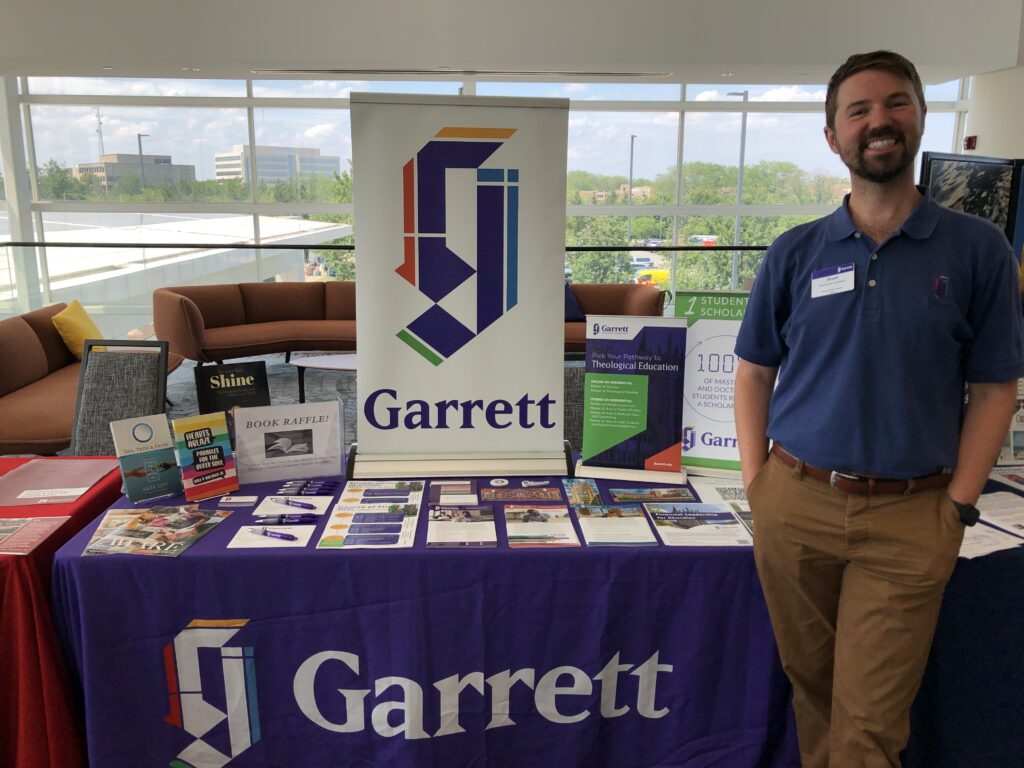
“Garrett has taken all the excuses away,” reflects Kent Lundy.
Kent and his wife Marti are Garrett Seminary “admissionaries,” people committed to representing Garrett to those who may be sensing a call to ministry, to theological education, or to a time of broader exploration and discernment. Admissionaries stay up to date on seminary news, meet with prospective students one on one or at educational events, and help connect prospective students with Garrett’s admissions team for further conversation.
Kent, a military chaplain himself, is excited to speak with those interested in military chaplaincy about the many resources available to them — including financial assistance through the United States Air Force chaplain candidate program — and, of course Garrett Seminary. Garrett, he says, has found the “sweet spot” balance between residential and online opportunities, one of the many reasons “there shouldn’t be any excuses for not seeking a seminary education anymore.”
Logistics of life at Garrett, particularly financial aid, are often a top concern of the prospective students. Fabiola Grandon-Mayer, Director of Connectional Ministries for the Northern Illinois Conference and a Garrett Trustee, encourages prospective students to “think big” about what might be possible in theological education whether they are interested in pastoral ministry or in something else altogether. To support those big ideas and aspirations, she also walks with them as they navigate logistics and financial barriers. For her, it’s an important way of giving back.
“I’m from Chile,” Grandon-Mayer said, “and I only had the opportunity to go to seminary because I was given a 100% scholarship from the institution where I did my MDiv. There are other people out there who have the passion, have the call, but don’t have the opportunities or don’t know the route. I feel called — first as a Hispanic woman then as Hispanic clergy — to help others the same way I was helped, the same way that I was shown the path to go.”
Admissionary Justin DaMetz, who regularly lunches with students at his alma mater, Oklahoma City University, also encounters considerable questions about the practical details of life at Garrett and in Chicago. As he describes the city, classes, professors, and the strong sense of community, he emphasizes that Garrett is a place for exploration, where questions are welcome. He also finds that many students are glad to hear that Garrett is open and affirming, and DaMetz is grateful to be able to offer this example of progressive Christianity.
“There is a fracturing culturally around who our image of a Christian is at a national level,” he said. “Cultivating the next generation, giving a different vision of what Christianity means, that’s really important work. If we don’t do that, if we aren’t cultivating people who want to go to seminary and kids who want to think about religion more seriously whether they go to seminary or not, then we’re ceding this religious ground to folks who are clearly bad actors and who want to use it in a way that harms people.”
The fractured culture DaMetz describes is also reflected in a fracturing church, making the prospect of theological education that much more challenging and that much more important. Admissionary Marti Lundy has served as the district superintendent of the Northern Lakes region for about five years, a period that has included both the pandemic and disaffiliation, when so many Methodist congregations left the denomination over issues of sexuality. During that time, she was encouraged by those who felt called to serve as United Methodist pastors and who were looking for “that grounded Wesleyan United Methodist theology” that Garrett offers.
“There were many times during that process when someone would come to me saying, ‘You know, I feel like God is calling me into ministry,’ and I would respond, ‘Really? Look at the mess that we’re in right now.’ And they would say, ‘Yes, God is still calling me and I want to be a United Methodist pastor. I want to move us forward as a denomination,’” she recalls. “That filled me with a lot of hope in some really dark days.”
For these admissionaries, prospective students are a source of reassurance even as they face very real challenges. It’s a good thing, then, that Garrett has not only removed so many barriers to theological education but is already living into what the church might become. As Grandon-Mayer describes it, Garrett works to “give access to everyone, regardless of race, gender, or ordination status. There are people who might never think to enter a seminary building, but now the seminary is going to them.”
For those interested in becoming admissionaries themselves, there is something they should know, Grandon Mayer says: “They can be certain that Garrett is a trustworthy institution with the legacy, the commitment, and the passion to change people’s lives. And they will be blessed in this work by more than what they expect to receive.”
If you’re interested in serving as a Garrett admissionary, please email Grant Showalter-Swanson.