

Learning Without Borders
November 3, 2025
Students enter the Garrett classroom from across the world
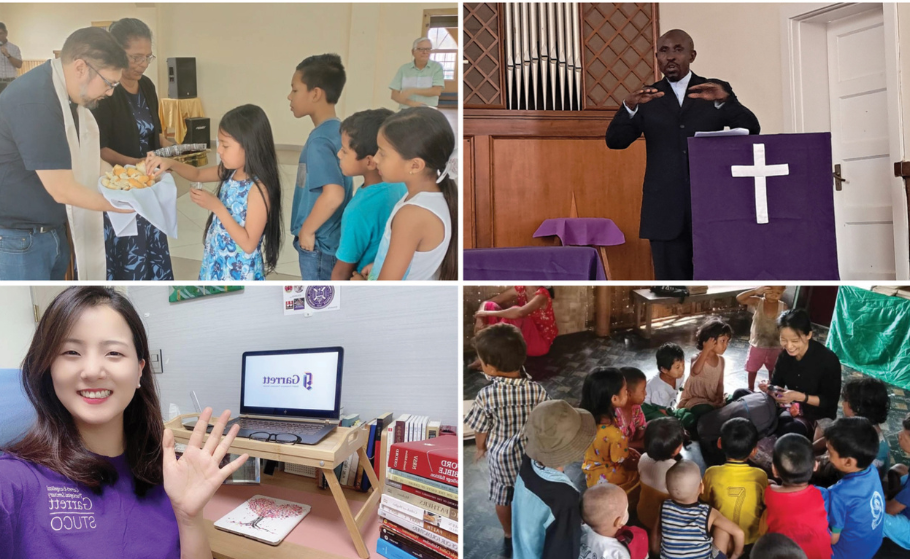
“You’re my yesterday and I’m your tomorrow.” In just seven words, Korean MAPM student Hayoung Esther Suh captures the glorious interconnection that sits at the heart of Garrett Seminary’s radical expansion in hybrid learning. Garrett now offers students the opportunity to complete several degree programs fully-online, including the MDiv, and the result has been a dramatic rise in the number of international students who enter the campus’ virtual doors. What has surpassed even remote education advocates’ wildest dreams, however, is how this shift increases access and broadens moral imagination. “Sometimes we get stuck where we are, and this offers flexibility and gives us a space of letting go,” Suh says. “God takes us beyond time and place, reminding us that we are not the center of the world. The classroom gives us a chance to move toward a truly communal center.”
There are many reasons that students choose to study online. For some, like second-year Myanmar MDiv student Mai Lin Lin Khaing, the visa process can present an obstacle to study in Evanston. “I thank God for the Garrett community. I’m so grateful to President Javier and the Garrett team for making such a strong visa recommendation and also for offering me a full tuition scholarship—without that, I would not have been able to enroll. Unfortunately my visa was still rejected,” Khaing shares. “But, now I’m grateful to have joined Garrett online because it has taught me to manage my time and energy effectively and has also greatly reduced my expenses, since I don’t have to worry about housing and other costs. Additionally, I’ve been able to apply what I learned in class to my ministry, like the way Dr. Teasdale’s evangelism class has enriched, inspired, revived, and equipped me to share the gospel of Jesus Christ boldly and authentically.”
Other students prefer to study online so their communities of accountability can shape their education. Chilean MDiv student Daniel Contreras, for example, serves as a missionary in Honduras, where he supervises more than 20 local pastors and offers training to ministers and laity. He’s seeking this degree so he can become an ordained UMC elder but did not want to uproot his life and ministry to pursue that dream. “This program is awesome because it allows me to serve full-time as a missionary but also devote time to studying,” he says. “I also needed to balance career and family—I’m a parent to 11- and 14-year-old kids. Now I can follow my call but also be there for my children.”
Similarly, MDiv student Makonga Mutombo reflects that the church he serves would face great difficulties if he were to leave and study in the United States, but he is working on training young adults to take over whenever he is not around. Mutombo fled the Democratic Republic of the Congo as a refugee but found purpose serving a church in South Africa, even preaching for a year when the pastor was on compassionate leave. “I’m directing the choir, teaching a confirmation class, and am ready every week to step into the pulpit in case we don’t have a preacher that Sunday,” he says. “My presence here, it helps a lot. If I’m not there, the church would struggle.” The reduced cost for an online degree also enables students to pursue graduate education who would otherwise be shut out. “I’m so grateful for this program and for my scholarship,” Contreras says with a wide smile. “It’s the only way I could afford this education.”
Regardless of the road that leads students to study online, what they find when they open their laptops is a global community full of passionate learners from five continents eager to share contextual knowledge that deepens any syllabus. “Sometimes it can be challenging to understand things from another point of view, but I’ve found that those different perspectives actually give us deeper insights,” Khaing notes. “The teaching style at Garrett welcomes everyone and respects their opinions, so we truly see and taste the beauty of that diversity.” As Mutombu remarks, it offers professors a wealth of experiences that transcend their own. “When they talk about Africa, they want to hear from us: What are we experiencing in our churches? We do research here and then share with others,” he says. “The same thing happens with students Korea, India, or Latin America. We all study together, and talk on an international WhatsApp group, mixing our perspectives. Now I have friends from all corners of the world!”
Suh brings a unique perspective to the online classroom because she studied in-person at Garrett during her MDiv program. Her program was interrupted by the 2020 COVID outbreak, so she has experienced both residential education and early forays into online instruction before starting this degree. “Online students who come to Garrett are so focused and passionate about their learning, it enriches all our classroom conversations,” she says. Just a couple weeks ago, she completed a group presentation with students from Indonesia, Minnesota, and Evanston. “We used Teams and shared Google documents, but the discussion about our presentation topic was so rich that I didn’t feel at all like I was missing out on the Garrett experience,” she reports. “I felt just as connected and lively in that moment as I did in conversations in the dorms.”
It’s also been a joyful surprise to witness the technological and pedagogical advancements Garrett has made over just a few years. “Those early online classes were held on Zoom, which is a very temporary space. Links disappear, it’s hard to keep notes,” Suh says. “Now the professors are so tech-wise: They upload to Moodle or Canva, they’re very active in reading the chat where online students are offering comments, they employ Padlet, Mentimeter, and other interactive tools. But their mindset has really changed as well—I don’t have to remind them about time zones, and they’re flexible with deadlines so mine isn’t at 2:00 a.m.” Online students also receive broad access to the Styberg Library, thousands of theological resources just a click away. “The library is huge,” Mutombo laughs. “It really stretches our knowledge.” The nature of online education also means that students build their own database of digital files and resources, collected along their journey. “Microsoft OneDrive has all the folders, all the files that we can access anytime,” says Contreras. “It makes it very easy, but it also keeps you accountable.”
Each student carries their own intentions for the ministries they will pursue upon graduation, leadership and knowledge rippling from Evanston to communities thousands of miles away. Khaing wants to enter children’s ministry, creating safe spaces where students are encouraged to think critically and freely about their faith. Mutombo wants to return to the D.R.C., helping to nurture congregations in the Eastern part of the country that has been ravaged in the civil war. “They will need more pastors to go and start from the roots, rebuilding churches,” he says. “I want to work in those fields. I like the bush, the rural areas—I’m a farmer by profession and studied agronomy at the university. I want to go home and serve the church.”
While those dreams are still on the horizon, what’s immediately visible is the love and beauty that grows in their midst. “I’m mesmerized, speechless by how the Holy Spirit moves across so many places, through so many people,” Contreras offers with reverence. “My class is wondrously diverse—it’s beautiful. Different nationalities, all colors; this is God’s work. It’s a garden, blessed with the fruit of love, and I am grateful to be there.”