

Learning Beyond Borders
September 22, 2025
How international students are shaping Garrett’s learning culture
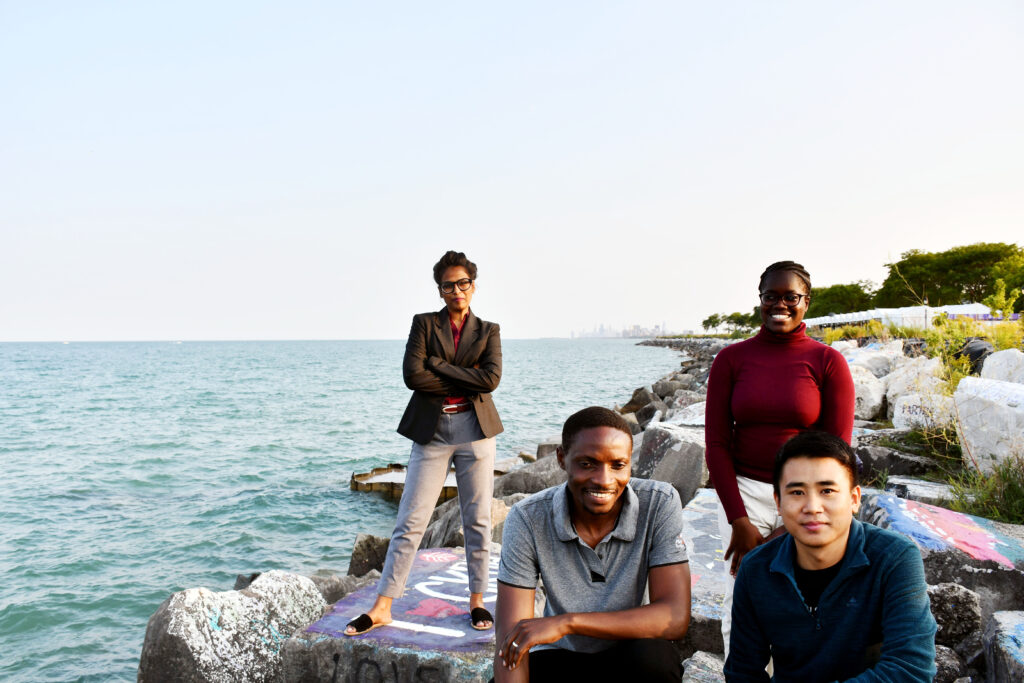
“I come from a people whose histories have been officially recorded for over 2,300 years. Our students bring those long traditions that still influence how they see the world, different sets of knowledge that enrich the entire community.” Dr. Anne Joh’s eyes light up when she discusses international student’s impact on Garrett’s classrooms. In her role as the Harry R. Kendall Professor of Christian Theology and Postcolonial Studies, this passion isn’t just personal, it’s also her professional analysis for how institutions like Garrett can commit to decolonizing theological higher education—and why all students benefit from that work. “Our institutions still sustain the aftermath of colonialism. It wasn’t just the military, the academy also carried out these projects,” she says. “How can we participate in decolonization if the people whose lives are affected by these experiences aren’t in our classrooms? Having students from around the world helps us unlearn an US-centric perspective and reimagine what it means to be human together.” By committing to this ethic through structural and epistemological changes, Garrett is building an educational community that reflects the global church, nurtures collaborative work, and deepens all students’ learning.
When Academic Dean Jennifer Harvey arrived at Garrett two years ago, she was delighted to find this process already well-underway. “Faculty conducted an audit of the entire curriculum, engaging one another around questions of who is on the syllabi, who gets read, which narratives are central to our pedagogy,” she recalls. “It’s very common in higher education for folks to say, ‘We want to center marginalized voices,’ but often Eurocentric, white, male perspectives are still experienced as normative. That conversation is fundamentally different when you have a faculty whose ‘center’ is profoundly global.” Nearly half of Garrett’s professors grew up outside the United States, hailing from twelve different countries spanning four continents. Those experiences shape education, for students and their colleagues alike.
It has also attracted unprecedented international diversity among the seminary’s incoming classes, illuminating new opportunities for cross-cultural learning. Rev. Paola Márquez is a Ph.D. candidate in Christian education with a minor in Theological and Ethical studies, and they are quick to name how transnational conversations impact their work. Born and educated in Colombia, Rev. Márquez’s doctoral research focuses on complicating Latine notions of mestizaje and its liberatory potential. “Because my work is particularly concerned with mestizaje’s relationship to Blackness, my thought partners have primarily been African American students and students from the continent,” they share. “It’s fascinating to see people asking similar questions about race and theology in Northern Africa and helps me bring more textured questions to my own project.” This intercultural exchange also decentralizes expertise and wisdom. “It enables us to become teachers for one another,” Rev. Márquez observes. “We cannot become attached to ideas of absolute truth but instead understand what works in each of our communities. Particularly now, Indigenous, Black, and other immigrant communities have so many knowledges of care and resistance to authoritarianism.”
The truth the community has uncovered is that the Christian values which shape flourishing faith communities also nurture a fertile, dynamic learning environment. “There’s already so much destruction in the world, we live it every minute,” Dr. Joh confesses. “More and more, I feel the Christian call to discipleship—to embody kindness and love our neighbor—has a powerful effect within the classroom, too. At the end of the day, when the world is on fire, what really matters is the life we create together.” Rev. Márquez is similarly quick to name the world’s impact, and how classrooms can incubate belonging to embolden students’ voices. “With so much fear, there is a level of anxiety and depression, especially when you are demanded to think and produce,” they share. “We need spaces that remind us we are supposed to follow our own calling, not let others decide what we can or cannot speak about.”
Ultimately, that deeper belonging is embodied in the journey many international students make to study on Garrett’s campus, and the gifts they bring with them. “We get the incredible opportunity as an educational community to prepare leaders from the very communities where the church is growing quickest,” Dean Harvey notes. “Expanding access for those learners contributes so much richness.” Indeed, as Dr. Joh observes, Garrett benefits not only from some of the world’s most prodigious students, but also from the entire communities investing in their vocation. “It’s not that we’re the benevolent nation to which these folks are coming, and they’re beneficiaries of our humanitarian educational goodness,” she laughs. “Students are multilingual, emerging from incredibly competitive educational systems, bringing their own rich histories. But they’re also sent by whole communities—aunts, uncles, cousins, and neighbors all pulling together to fund as well as pray for their being here.” As Garrett trains leaders to serve communities and bolster collective flourishing, these students’ stories are a living testimony to what people can accomplish through love and dedication. They’re an invitation to travel further together. “We all must work on the self-decolonial project to find the mental liberation that comes from that unlearning,” Dr. Joh concludes. “That process is always mutually enriching.”