

Just Like Jesus
October 30, 2025
By Allie Lunblad
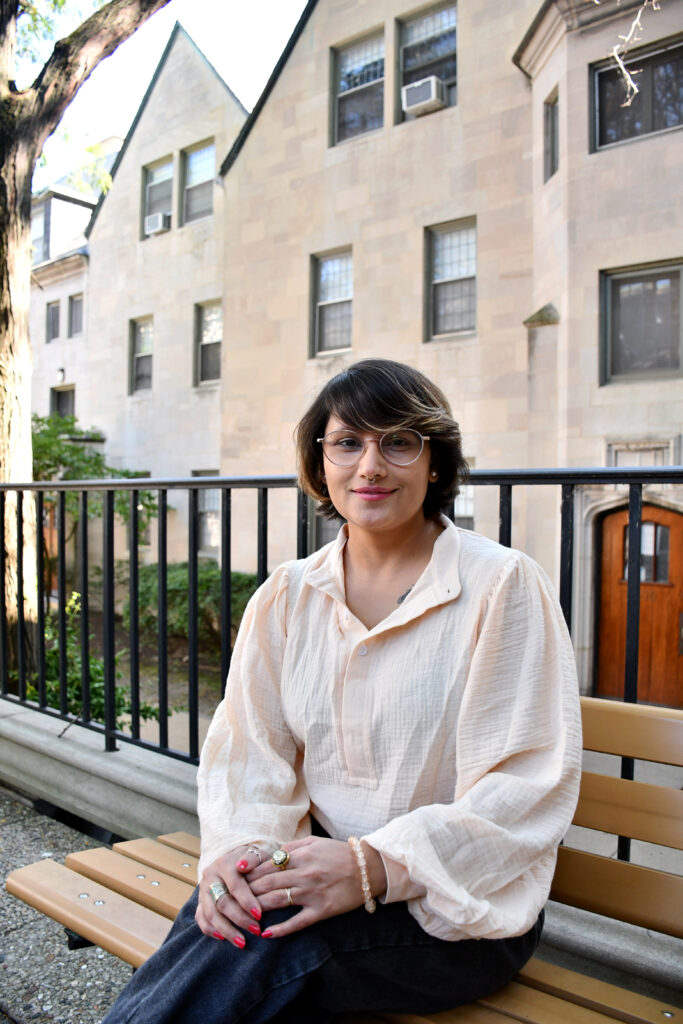
Aabiskar Sharma is a big fan of Jesus. Their vibes match.
Jesus, after all, empowered women, cared for everyone, and sought justice for the marginalized. Those are Sharma’s passions, too.
“And Jesus was a forgiver,” she adds. “I’m a forgiver too. As Martin Luther King Jr. said, hate is too much to take and love is so easy. With Jesus, it was all about love, love, love. He would go to the tax collectors, be with them, and just forgive. We should do that. We should learn how to forgive more.”
Sharma, who was born in Nepal, remembers a childhood full of questions about things that just didn’t seem quite right to her. Why, for example, did her family serve lower caste workers with an entirely different set of utensils than the family themselves used? Why were boys allowed to play outside while girls had to spend their time “learning to be the ideal wife?” And why were “all the women in the kitchen working while all the men were outside of the kitchen enjoying the food?” Sharma remembers being told that as a woman she would have to compromise. She was unsatisfied with that answer and that vision of womanhood, for herself or for others.
“It was so hard for me to find that role model where I could say, ‘Oh, I want to be like her!,’” Sharma says. Then one day, scrolling through YouTube, she came across a documentary about Malala Yousafzai. Malala’s story — her advocacy for women’s education and her perseverance even after being shot — was inspirational. “That was motivating. She was a role model for me. For a girl who was in Nepal and struggling to find a role model who could help me, she was the one.”
Sharma’s own passion for learning also started young. She remembers going over to friends’ houses and ending up with the adults, watching the news, wanting to “know big things.” As an adult, Sharma became a nurse, and it was in nursing school that she first encountered psychology through a class in Behavioral Science. Working at a rehabilitation center, Sharma talked with patients’ families about the stereotypes and taboos that people face when struggling with mental illness.
“We were there to support them, and they were really thankful,” she says. “They were so happy that there are people who really care about it. I told them that I was really interested in addressing mental illness and maybe in the future I would want to do psychology. They were so happy, I was able to see the need.”
Eventually, Sharma did go to India to study psychology and then made the decision to come to the United States for further education after she was encouraged by Bishop Laurie and Rev. Gary Haller, United Methodist clergy whom she’d met in Nepal. They took her to visit Morningside University, where she then completed a degree in Counseling Psychology, Religious Studies, and Non-Profit Management.
Sharma’s friendship with the Hallers also coincided with a major shift in her religious life. Just a few months before meeting them, Sharma, who was raised as a practicing Hindu, attended a service with her sister at the Punjabi Church of Signs and Wonders.
“I felt something, and it was weird,” she said. “I was like, ‘Huh. Let me check out who this dude Jesus is.’ Then I started learning about Jesus on my own. Nobody forced me. I was going through Google, searching Bible verses and learning about Jesus.”
After arriving in the U.S. for school, Sharma asked the Hallers if they would take her to visit church, and they readily agreed. Then, at a United Methodist Church in Milwaukee, Sharma again experienced that sense of connection and welcome and decided to be baptized. When the Hallers suggested that she look at Garrett for graduate school, Sharma was excited that she could study to be a counselor and nurture her faith at the same time. She was also impressed by Garrett’s values and the fact that it was founded by a woman, Eliza Clark Garrett. Plus, Chicago reminded her of Kathmandu.
“There is something about Chicago that reminds me of home. We don’t have such huge buildings, but still there is something. Maybe it’s the people,” she says.
Now, Sharma is excited to be here. She has plans to earn the M.A. in Pastoral Care and Counseling and then return to India where she hopes to start both a counseling practice and a nonprofit that supports education for women. She also envisions doing doctoral work with a focus on intergenerational trauma before too long. Despite the challenges, she’s committed to providing care for people who otherwise would not have access or be able to afford it. Sharma hopes to help as many people as possible — just like Jesus, but with her own spin.