

Finding Care
September 24, 2026
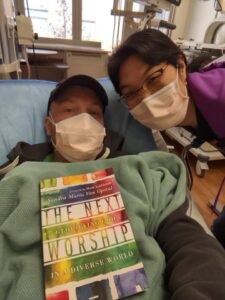
“We lived my husband’s journey of cancer since 2018,” reflects Jane Menning, a new student in Garrett’s Master of Arts in Pastoral Care and Counseling (MAPCC). “The treatments, the caregiving, the uncertainties. And in that process, we met chaplains at the various institutions where my husband was receiving treatment.”
The American medical system can be draining, physically, emotionally, spiritually, and perhaps not least, financially; especially in the face of a significant diagnosis. In a system where 12 to 24-hour shifts are not uncommon, the focus of care is often limited to treatment of the illness rather than the whole individual. Even more rare is an attention to and care for the families and communities that support them. In that system people yearn to be known and cared for by name, not by diagnosis. Chaplains step in to fill that void.
“When I think about what we needed then,” Menning says, “it was a compassionate presence in the middle of the storm. We needed someone who could be an emotional shelter for individuals, and whole families as well. Chaplaincy involves not just making space for one person, but all the other relationships and support systems that are connected to their healing as well. Having a chaplain available made the non-physical aspects and realities we were facing feel valued and offered a more holistic view of healing and living.”
In the process of receiving care, Menning realized she felt called to offer that same gift to others. “I began to see in myself gifts that have led me to consider a ministry of presence,” she notes. “In spaces facilitated by these kinds of caregivers, I found a clearer image of what the work of chaplaincy might look like for me.” This sense of openness and radical hospitality characterizes the ministry of presence that is cultivated in Garrett’s MAPCC program. “I have empathy, I want to do this, but I need more, ” she says. “Now, I’m glad to be formally learning these skills.”
A chaplain’s work is always in some ways ephemeral, some relationships may last only a single visit while a person is in the hospital while others may go on for some time as a person stays at and returns to the hospital over the course of prolonged treatment. This creates a need to embody a radical sense of compassion, supporting people right where they are. In her encounters with various chaplains, Menning describes a subtle relationship, less defined by profound moments than the steady gift of having someone there to both simply be with and to attend to the spiritual and emotional aspects of care amidst the clinical trials and physiological testing.
Though it might seem simple, that gift leaves a lasting impact. Menning remembers the work of a particular chaplain, Mary, “It was during COVID and she made it possible for our pastor to hold a prayer service ahead of one of my husband’s procedures over Zoom. She listened to us, helped us with resources, and helped us plan and connect with our own faith community. She was a bridge builder. I want to be that for other people.”
Emotional wellbeing is also intimately tied to physical healing. In the process of receiving care based on genuine presence and hospitality Menning recalls having the realization that “caregivers have just as much of a role in the healing process as the patient themselves.” Through the process of caring for her husband and family through the realities of cancer, as well as with others facing difficult end of life circumstances, Menning discovered in herself “a natural instinct to care for the person in front of me through first hearing their story, getting to know them, before inviting them into something else.” As Menning reflects on her call to chaplaincy she recalls her own exposure to different concepts of healing and wellness while living in China for several years. She reflects, “I’m Chinese American, and while I was raised here in the US, I felt like parts of myself came together and integrated in Asia.” There, she found people devoting particular attention to the seasonality of food, offering ways to synchronize with the cycles of nature. “My background is going to be different than the people I might accompany, but having my eyes opened and my worldview expanded by living there helps me relate better to people who might come from cultures that differ from the Western context.”
Menning highlights the importance of a culturally responsive and diverse education in her own discernment and ultimate choice to study chaplaincy at Garrett. “I realized, growing up in Minnesota, that my perspective has already been shaped so much by that one perspective,” she says. “So, if I really want to be someone who can connect with people and accompany people from all backgrounds, I need to enrich my education by being in a more diverse setting.” Menning found that blessing on Garrett’s campus. “When I visited and looked at the list of faculty, I saw that faculty in the MAPCC program represent perspectives and lived experience from four different continents,” she explains. I thought, ‘This is where I want to learn the skills that I will need to answer the call and become a chaplain.”
Menning brings vibrant curiosity when she describes the work ahead. Chaplaincy can help people find their voice and speak amidst the unspeakable—a gift she knows intimately from journeying alongside her husband. As she enters the MAPCC program, she’s ready to return that blessing. “I won’t always fully know or understand what people’s context for healing and wholeness are,” she admits. “But I want to be able to have the language and tools to search that out with them.”