

Faithful Preaching for Our Times
October 30, 2025
Celebrating 20 Years of the Styberg Preaching Institute
Since its beginning, the Styberg Preaching Institute has sought to support preachers amidst the frustrations and challenges of both church life and contemporary culture. The 20th Anniversary event on October 7-9 was no different.
The workshop gathered nine preachers and presenters for a three-day conversation with Dr. Gennifer Brooks and Dr. Andrew Wymer on the topic of “Faithful Preaching for our Times.” Rev. Dr. Marvin McMickle, Rev. Dr. Luke Powery, Rev. Dr. Gerald Liu and Rev. Dr. Otis Moss III offered plenary addresses that explored the meaning and challenge of faithful preaching. Rev. Dr. Valerie Bridgeman, Rev. Dr. Sarah Travis, and Rev. Dr. Michael Woolf expanded on the theme with explorations of disinformation, authoritarianism, and Christian nationalism, respectively. A “Pastor’s Panel,” which included Dr. Woolf along with Rev. Grace Imathiu and Bishop Dwight Riddick, Sr., delved into the implications of these crises for the church.
Throughout the event, speakers emphasized the importance of naming these challenges. During a panel discussion of his plenary address, Dr. Liu did so by reflecting on something he’d heard Jim Wallis, author of God’s Politics, say once: that cynicism is the opposite of hope. “I personally would counter that by saying it’s impossible to hope right now unless we’re cynical,” he said, “because without cynicism, I don’t think we can name what is actually evil about what’s happening. The reality is, we need to be cynical about what’s happening. We can’t stop there, and we also can’t become frustrated if we don’t see society or the kindom of God advancing the way we want it too.”
Over the last 20 years, the Styberg Institute has helped countless preachers to speak truth and inspire hope. Endowed by lifelong United Methodists Ernest and Bernice Styberg, the institute has carried out its mission under the leadership of Dr. Brooks. Garrett students as well as preachers within and beyond the United Methodist Church have benefitted from the creation of the Styberg Teaching Fellows position, facilitation of peer preaching groups, support for organizations like the Academy of Homiletics and Black Clergy Women of the United Methodist Church. The Institute has also hosted numerous workshops, in person and online, both domestically and overseas.
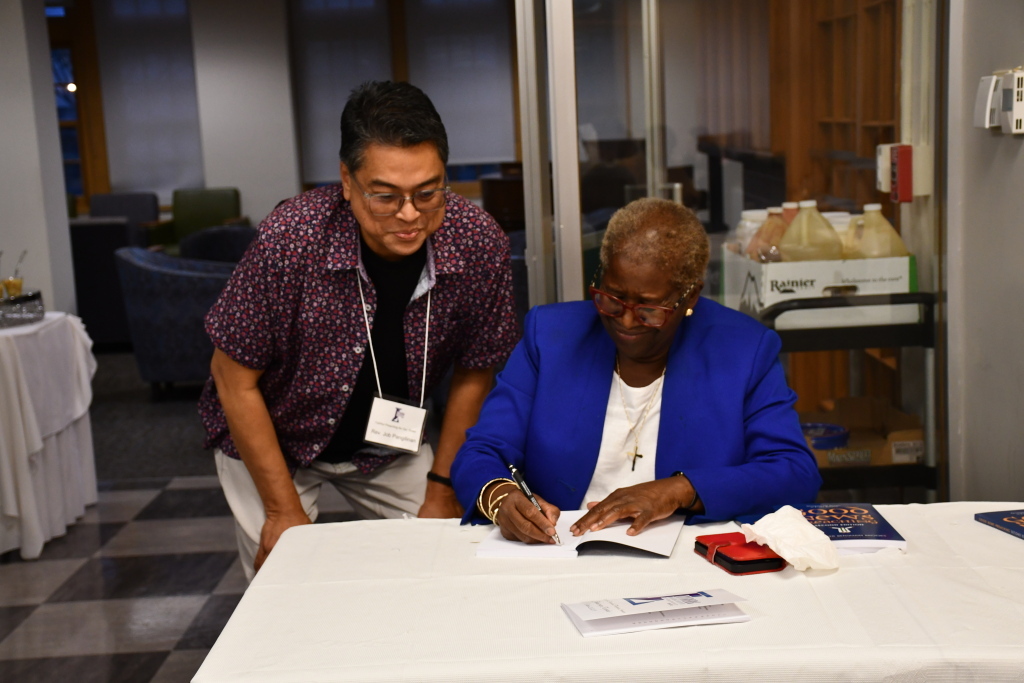
The Garrett community was invited to celebrate this history with a special chapel service and dinner, which included the launch of the second edition of Dr. Brooks’s book Good News Preaching and the Good News Preaching video course, now available on the Garrett Collective. During the chapel service, Dr. Brooks presented special awards to two people who had been of particular service to the work of the institute. She told stories of Rev. Jacqueline Ford’s readiness and willingness to help in the early days of the institute and today and of Dr. Wymer’s good work as a student and then as a colleague.
“God sends people into your life at a time of need,” Dr. Brooks said as she presented the awards.
The preacher for the evening was Bishop Riddick, who named the stormy situation of the present day even has he found an anchor in Jesus: “To be sure we’re living in a season where the confidence of so many people has been shattered,” he said. “We look around and we see cultural chaos, mass shootings, political division, moral confusion, racial tension and economic uncertainty, our young dying in the streets. Like the disciples, it feels like the wind and the waves are beating against the boat and we ask, ‘Lord, where are you in all of this?’ We are witnessing the unchecked decisions that are flowing from our nation’s capital like a mighty rushing flood and no one in authority seems to be saying a word.”
Wind and waves were only some of the powerful images offered to describe both the present moment — with its authoritarianism, nationalism, and historical revisionism — and the call to preach faithfully. Rev. Dr. Marvin McMickle advised attendees not to “preach us into content with the status quo” or to “imagine a time when it is ever acceptable for a Blackhawk helicopter to hover over an apartment building…in Chicago,” in reference to the recent immigration raid. Rev. Dr. Valerie Bridgeman drew on the maxim that “falsehood flies around the world” to invite listeners to slow down enough to find truth in the midst of so much disinformation. Rev. Dr. Sarah Travis referenced the popular children’s book to say that “the emperor may be naked, but the emperor still has the nuclear codes” as she named both the risks and the resources for speaking the truth when the empire “wants us to believe that our subversive speech is like spitting into the wind.” Rev. Dr. Otis Moss III envisioned the preacher as a DJ and asked listeners to consider whether there is enough musical variety in their crate, and a variety of perspectives in their preaching.
Rev. Dr. Luke A. Powery also evoked the musical tradition in his plenary address as he shared a story about teaching a divinity school course on the spirituals in a federal prison. After a class discussion on lament and hope in the spirituals, specifically “There is a Balm in Gilead,” one of his incarcerated students showed him a drawing of the word “lament.” He had drawn a box around the middle four letters, demonstrating to Dr. Lowery that there is an “amen” in every lament.
“I’d been researching lament in preaching and theology for like 20 years, and I had never seen that. A so-called threat, a prisoner, became my homiletics professor on that day,” Dr. Lowery said. “Faithful Christian preaching voices the ‘amens’ amid our laments. It allows us to hear the bombs exploding in life yet also helps us hear the balm in life. One might even say that faithful Christian preaching is a balm amidst the bombs, an articulation of an incarnate hope.”