

Dr. Esther Acolatse is named to the Harry S. Kendall Chair
September 16, 2025
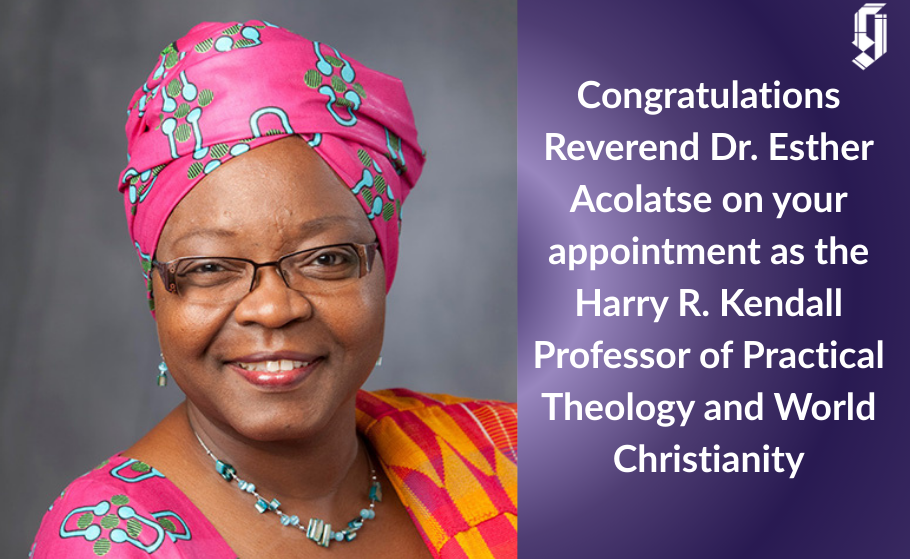
Garrett is delighted to announce that the Reverend Dr. Esther Acolatse has been appointed to the Harry R. Kendall endowed chair, and begins this academic year as the Harry R. Kendall Professor of Practical Theology and World Christianity. A much sought-after expert in the fields of World Christianity, global theologies, and pastoral care, she has been teaching at Garrett since 2022, and the seminary celebrates this further step to expand her research and honor her contributions. “Dr. Acolatse is a highly regarded scholar of the global church, its movements and practices, and especially the role of pastoral leadership and care. She is a cornerstone of our pastoral care and counseling department, and our chaplaincy program in particular” says President Javier Viera. “We are blessed to have her wisdom, her scholarly voice, and her administrative leadership among us, and I’m thrilled for this new chapter in our journey together.”
Previously the Professor of Pastoral Theology and World Christianity, Dr. Acolatse has taught at numerous institutions, including the University of Toronto, Duke University Divinity School, and Loyola University Maryland. Trained at the University of Ghana, Harvard University, and Princeton Theological Seminary, she is the author of numerous publications, including Powers, Principalities, and the Spirit: Biblical Realism in Africa and the West (Eerdmans, 2018), and For Freedom or Bondage: A Critique of African Pastoral Practices (Eerdmans, 2014). Her research and writing have been recognized with numerous awards including the Carnegie Africa Diaspora Fellowship and Duke University’s Julian Abele Mentor of the Year. She is likewise an active member of many academic guilds and serves on the board of the Council for the Development of Social Science Research in Africa College of Mentors and, previously, the Board of Commissioners for the Association of Theological Schools.
Dr. Acolatse’s professional journey across both continents and research areas offers clear expression to what it means to embody an interdisciplinary approach. “I feel like every time I hear about a new article she’s written, it’s on a completely different topic for which her expertise is known in other parts of the world,” says Academic Dean Jennifer Harvey. “She’s an incredible intellectual, deeply committed to people and the church, and you feel that in the way that she leads—not only with students but with her colleagues. She’s a scholar with liberationist theological commitments who also embodies those ways of being in how she shows up as a human.” This opinion is echoed by Ph.D. student Charles Adonteng, fortunate to study with Dr. Acolatse as his advisor. “I have not only observed her unique and expansive teaching approach, which includes perspectives from marginalized communities, especially from African cultures, but I have also experienced the pastoral care environment she co-creates with her students in the classroom,” says Adonteng. “This environment makes the learning space vulnerable, encouraging students to think and engage confidently in the seemingly impossible.”
Aware took the opportunity to interview Dr. Acolatse about her approach to the field of pastoral care, and where her research is headed.
Why is theology important when understanding care?
We all have faith enough. People may say they don’t believe in spirits, principalities and powers, outside things that control us, but we give ourselves every day to invisible forces, let them intrude in our lives. We have driverless cars! People are primed to believe that something higher than them is responsible for their care. There’s always that tacit dimension, an assumption in a symbiotic relationship with beings we cannot see.
Erikkson puts it well when he starts his psychosocial development with navigating trust versus mistrust, making hope the linchpin rather than despair. If you navigate trust versus mistrust well enough, what you get is hope. That is what unlocks all the other developmental trajectories—they depend on hope in this transcendent other. This notion was always among humans until the Enlightenment. We all had an idea of a spiritual presence that we assumed real in our physical life. Coming from that perspective means that you enter pastoral caring with the assumption that God is already present in how different cultures name and narrate their caring needs. That is what you must use to try and help them, instead coming from outside their cultural understanding of what is happening.
How do you train students to care within this paradigm?
It begins with inculcating attentive listening skills, making sure that they are aware of their own cultural biases so that they can listen to people across cultures. We must move them beyond sympathy with the person and their cultural perspective, even past empathy, to what we call interpathy. You are still situated within your culture but can move into the other person’s culture and return to your own having learned something that facilitates true dialogue. You create a caring environment that where the other sees you, seeing them—a multidirectional seeing and being seen.
There is also a delicate dance between Christian or received theology and psychodynamic processes. It is the internal work of the caregiver to navigate your own understanding of the presenting problem and how you read their culture, both theologically and psychologically. We must understand that what is most important is the care of the person, their flourishing. How can you offer care without diminishing their cultural and religious perspective, helping them flourish even within a psychospiritual perspective that may be intertwined with the problem’s source?
Their ability to function psychologically trumps what you assume to be theologically right. Even if they misunderstand the work of the Spirit and the work of Jesus in their midst, it is more important that you first give them psychological resources. Then, as you continue to work with them, you can begin to flesh out what is theologically inadequate in their account of what is going on. But I tell students, please don’t bring your Jesus and replace their Jesus with your Jesus. That is not how we do it, because they need that Jesus.
What is unique about Garrett as a learning environment for pastoral care and counseling?
Garrett’s approach is both person-centered and reflects systems theory. However, we are not only trying to care for the individual, we are also asking what destructive features in the individual’s environment impinge on their flourishing. So, in my course on psychologies of liberation, we discuss how race, colonialism, and patriarchy work together, how to give people resources for dismantling that harm.
We are also one of the most diverse faculty and student populations that I have experienced. We have a way to think globally with people that enhances our own local contexts. I invite students to think scripturally, from their local languages. What does your mother tongue say when you read the scripture? That is the one literature that we all have in common, and when we each bring that to our conversation, we receive a richer perspective for how we think about God, and how we then deal with the messiness of life that is presented in the individual caring encounter.
Where is your research leading you now?
I’ve always tried to get the Church to think globally as well as contextually. My work straddles Africa, which I know best, and the West. Currently, I’m working on how we can remission the church in an age of migrant angst. What is the global church up to? Why do we seem to have lost our voice amid everything that is going on? I’m not hearing the church speaking to this moment.
In addition to how how we can care for migrants among us, I want to see if I can teach the church to learn what repentance and forgiveness looks like for past mistakes, even for future ones, while still doing the work. My people say that is only the one who goes to fetch water from the river with a clay pot who breaks the pot. If you’re not doing anything, you’re not going to make any mistakes. Mistakes are for people who are doing things. And fear of mistakes should not prevent us from doing what needs to be done.
Why is the Church struggling to respond in this moment?
It feels to me like the Church is no longer a scripture people. We are more likely to pull a sociological or psychological resource to deal with our issues than a theological one. Then, we work in an arena where people can best us because they are the gurus of those resources we are pulling. How can I return us to our main resource? People already come primed, reflecting theologically. They may not name this theological reflection God, or even a personal being. But there is already in that tacit dimension a primal cry, always reaching to transcendence. God has made this person fully free while fully loved, these are the bounds. How can I help them navigate their life within these two truths? If the only way I can read human brokenness is psychological, sociological, without a theological understanding, then I am in the wrong place. But if I can say it is running away from the self that God intended us to be, which is causing all our issues, if that is how I refract even the word we call sin, then I have work to do, confronting the refusal of the self to be the self it was made to be.