

Always in Community
September 15, 2025
Garrett’s Course of Study sparks insight as colleagues and contexts connect
by Allison Lunblad
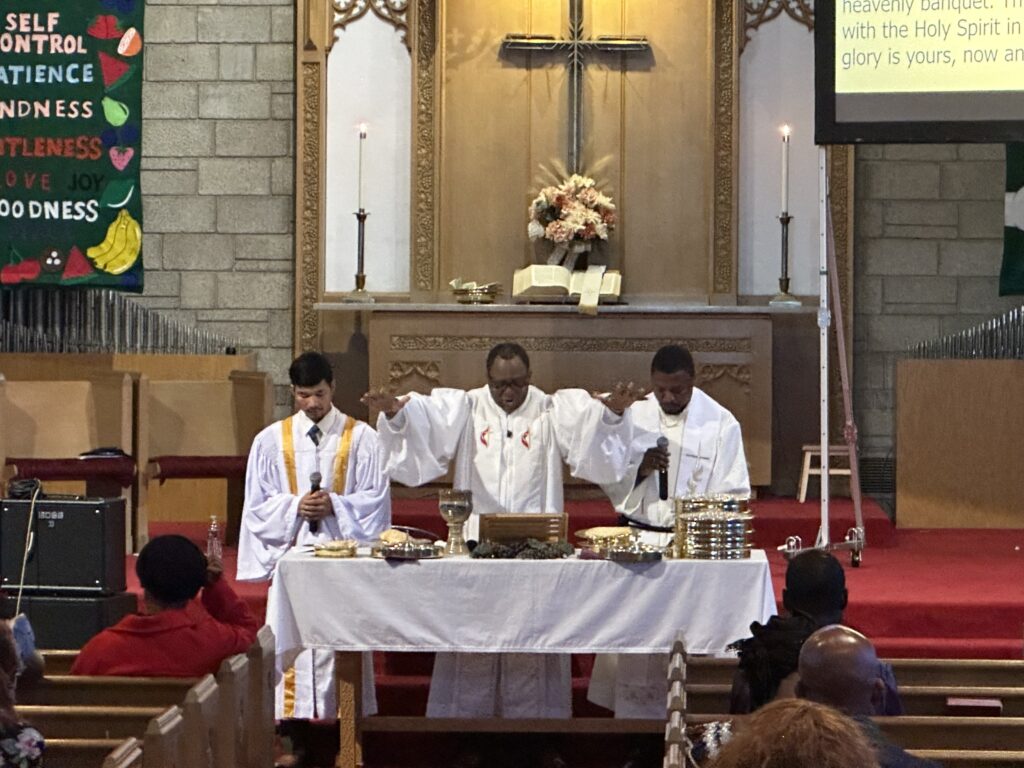
“I’m not surprised, and I got to see it!”
As Course of Study student François Russell tells the story, his mother’s response upon hearing that he had been called into ministry was immediate. He was her long-awaited miracle baby, and she had known there was “something special” about him. Others had too. Russell, like his father, had been a part of the Methodist church all his life, first in his home country of Liberia and then in the United States. He remembers people encouraging him even in high school to enter ministry, but always considered himself more at home backstage.
Then, in 2017, he walked into church to set up equipment for worship and was overwhelmed by a sense that God was calling him into a different kind of leadership. There was “no turning back.” On that day — after Russell had prayed, worshipped and returned to tell his family that he’d been called into pastoral ministry— it was his stepdaughter who affirmed his call.
“Daddy,” she said, “I think you would be very good at that.”
Russell, who now serves as the pastor of Albright Trinity United Methodist Church and Solomon Community Temple United Methodist Church in Milwaukee, Wisconsin, is one of the hundred or so students in Garrett’s Course of Study program who bring stories of a call that resonated within and was affirmed by their local communities. These are students who have been licensed as local pastors by the United Methodist Church—appointed to serve in specific communities—and are required to take at least two Course of Study courses annually to maintain their license, so they can continue to serve their congregations.
Those local congregations are just as important a part of the learning process as the curriculum itself. For Audrey Rochet, pastor of Centennial United Methodist Church and Brooke Road United Methodist Church in Rockford, IL, Course of Study learning makes its way into sermons and small groups, where it’s fun for the congregation to hear about what she’s doing and “actually opens up conversations that are healthy for the church.” Without such supportive people, Rochet says, she wouldn’t be able to serve two churches at once.
Learning flows both ways: Rochet brings stories from her congregation into in the classroom, too. She describes students and teachers alike offering examples from their own contexts during class discussions, sometimes workshopping problems together and at other times simply learning from her peers’ different understandings and practices.
“It opened up a beautiful world,” she said, “experiencing different cultures. Not every congregation is the same. Not every culture is the same, which makes it even more beautiful to see how God works within us. It’s such a blessing to have such a diverse variety of teachers.”
Teachers in the course of study program hold a doctoral degree in their field and ordination in the United Methodist Church. Rochet was grateful to learn that her teachers were pastors who understood their students’ questions and could offer knowledgeable, practical answers.
Rochet, who grew up speaking Spanish and English and currently serves in a multicultural congregation, has completed much of her Course of Study work in Spanish, which she felt was both comfortable for her and relevant to the Spanish speaking congregations she served at the time. Garrett is one of only two seminaries in the country that offer the United Methodist Course of Study program in Spanish.
For Rochet, it’s another example of Garrett’s commitment to celebrating diversity. She recalls a class in Theological Heritage taught by Dr. Daniel Rodruguez-Diaz who spoke to the context of Latin American religion and emphasized how different practices and traditions are meaningful to different congregations.
“It helped me so much to understand that even though we may worship differently doesn’t mean that people don’t understand God in their lives,” she said.
Like Rochet, Russell felt affirmed and encouraged by his colleagues and teachers in the Course of Study Program, often because of their willingness to challenge him. He finds himself grateful now for professors who met with him one on one and pushed him to rewrite papers, think more deeply, and elaborate on his ideas. He also remembers being challenged in the classroom itself.
In one pastoral care class, Russell, whose congregation had voiced their appreciation for his pastoral care, insisted several times that he was “not a counselor.” His professor responded emphatically, insisting that, by virtue of being a pastor, he was already offering a form of counseling, too. After wondering why she was being so hard on him, he realized that people would be coming to him with problems and he needed to be ready to respond.
“I took that,” he said. “It was hard to swallow, but here I am today. I’m talking to people going through different issues in their lives, transitions, you know. I feel proud of that.”
These experiences of challenge were, for Russell, balanced with an assurance of support. He describes Garrett as a comfortable place, “a safe environment. You know, you had an opportunity to speak and speak openly, right? That’s exactly what I experienced there. They sharpened my pastoral skills and helped me grow in my calling to serve God.”
Russell continues to experience the support of his communities and family, too. His mother, who had been unsurprised but excited to hear that he was entering ministry, called him twice a day to pray with and for him, until she passed away in 2021. Russell, who’d thought of himself as a “behind the scenes guy,” preached at her funeral service, quoting what she had written, words that he still incorporates into sermons today.
After all, ministry is not something any of us undertake alone.