

The Wisdom of Community
October 6, 2026
“I knew I wanted to go to seminary. I just didn’t know how I was going to be able to do it.” Jeremy Villoch-Galarza joins Garrett Seminary as a new student this semester, blessedly on the other side of that difficult decision. “When the opportunity came for the Laity Discernment Cohort, I completed it, even though I hadn’t completed my undergraduate degree yet, because I knew I wanted to go to seminary right after my undergraduate program. So that’s the reason why I’m here.”
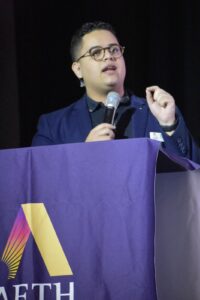 As part of the LDC, Jeremy participated in four conversations about vocation with faculty and staff including President Javier Viera, Academic Dean Jennifer Harvey, and Dean of Students Thehil Russelliah Singh. The conversations invited participants to not only reflect on their own sense of call, but also to explore the doors that different seminary degrees can open. All LDC participants take a seminary class, and he was struck by the diversity of voices in the room—and the insistence that every one of those voices mattered.
“When all these different perspectives come into a classroom, they can grow together and make something better,” he says. “That’s why I came to Garrett, actually, because it’s a place of respect. It’s a place where we can hear others’ perspectives.”
Villoch-Galarza enters this year as a joint Master of Divinity (MDiv) and Master of Theological Studies (MTS), with plans for ordination with the American Baptist Churches of Puerto Rico and then, later, a PhD. His choice of degree programs reflects his passion for education as vital for the transformation of the church. “It’s not that I’m saying people are not educated,” he said. “It’s just that we have to go deeper in our education with them. We as the church need to be in a continuous education process into what we know, what we feel, what God wants to tell us in this moment. I believe that will be the path for my pastoral ministry.”
In his MTS studies, Jeremy plans to focus on the relationship between church and state, as a catalyst of human rights and human dignity in relation to the Imago Dei. As he sees it, part of the work of the church is raising critical awareness of the significance of human lives and the protection of the common good. That kind of critical awareness not only creates more effective support for human rights and social justice, it helps people connect more fully with the gospel.
The option to attend Garrett remotely while continuing to live in Puerto Rico gives Jeremy multifaceted support to pursue this passion. Not only is it more affordable, it allows him to apply what he is learning in his own community in immediate and fruitful ways. “Being able to learn the tools that our community needs, it’s something that will help me go forward,” he said. “Because I’m not just here receiving those tools. I can also apply them into context. Then I can come next week and I can ask the professor, ‘We said this last week, and I tried it, but can I use this approach instead of that one because it’s what my community needs?’ And then the professor can guide us through those different approaches. That’s why I think being part of the community while we learn is important.”
It’s precisely this kind of education, one that combines powerful ideas with lived experience, that Villoch-Galarza is passionate about. Taking his cues from Paulo Freire, he describes the power of education that draws out the wisdom of the community. “I go back to education not because we want to say, ‘Hey, this is what theologians say about this.’ No, it’s about what theologians say and how we in our culture can interpret them,” he observes. “Then we can combine them and a beautiful flower will grow and lead us to a church that serves better. That’s why I think that education is important. That’s the reason I want to do my PhD: Because I know that we can change lives.”