

Honest Work
September 23, 2026
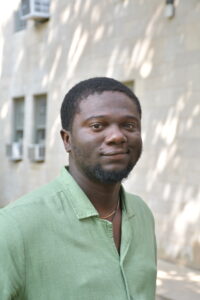
“I think what God wants is just for me to be honest with myself.” A simple summary for a mountain of a task. For Oluseye Fakinlede the journey towards living into this call has led him from Nigeria to Nebraska, and now to Garrett where, this fall, he enrolled as an MDiv student.
“When I finished my undergrad, in English and Literature in Nigeria,” Fakinlede reflects, “the popular belief was that if you study language, what you should do after school is become a teacher. But I didn’t want to teach.” He was drawn towards writing, and relocated to Lagos to pursue a post-diploma certificate in journalism before working as a freelance journalist.
“I was reporting court stories. I was reporting cultural stories, political stories, education stories. But, what I wanted to write about are stories of people, marginalized people,” he notes. “I did not want to put that on the paper because I was worried about the reaction that my editors would have. So, that’s how I began to write the stories I actually wanted to write—by sending them out to international publications.”
Fakinlede recalls articles written in sources like African Arguments and LGBTQ Nation that highlighted these stories on the margins, from night-shift workers affected by inequitable transit systems to descriptions of how queer Nigerians navigate discriminatory social conditions and live with multiple marginalized identities.
“I think one of the ways I can show people full love and support is by telling their stories, letting people know how it is to be someone that loves differently,” Fakinlede says with passion. “The reason why I wanted to write these articles is not only because they are other people’s lived experiences—they are also my lived experience.”
Fakinlede’s own experience of marginalization as a queer person led to him to step away from Christianity for a time. “I actually made an inquiry about pursuing ordination back in Nigeria after my undergraduate studies, but I got to a point where I wasn’t okay with what was happening in the church anymore,” Fakinlede reflects. “I was wrestling with some internal questions about my identity, my faith, and whether I could pursue ministry while living honestly as myself.”
Although Fakinlede found freedom from expectations and judgment alongside a more expansive sense of empathy and connection to others as he withdrew from Christianity, he returned after reflecting deeply on the words “God loves me,” resolving to start a new journey with baby steps. Eventually he decided to pursue a master’s degree in journalism and enrolled at the University of Nebraska. While in Nebraska, he joined an St. Marks on the Campus—an Episcopalian parish—and began to rediscover and reconstruct his faith as a Christian. To his surprise, six months into his program, his sense of call returned.
“That level of acceptance—the personal honesty that God wanted for me all this while—that’s the reason why He must have brought me here to the States,” he says. “If God knows all things about me, and wants me to be myself; it gives me the liberty and confidence to say yes to God. God knows my heart and has placed this desire for the priestly vocation within it. So perhaps He brought me to a setting in the Episcopal Church—which is thankfully affirming and inclusive—where I could be free to be honest and answer that call.”
With the help of his rector in Nebraska, his parish, and its discernment committee, he felt affirmed enough in his call to pursue an MDiv degree rather than a PhD program, while he works toward becoming a postulant within the Episcopal Church. During this period of discernment, Monica Magoola, a United Methodist licensed pastor, recommended Garrett.
Researching Garrett and looking through the website, he recalls thinking “Well, this actually the kind of institution I would like to be at, because of the progressiveness of the of the theology, and the diversity in the faculty and students,” he says. “And when I saw on their website that I can take classes at Bexley Seabury (the local Episcopal Seminary), I made the decision to attend. Now, if I become a postulant in the Episcopal Church, I can take Anglican Studies classes with Seabury, but I can study in a place where I feel at home.”
In addition to the access to diverse courses from a variety of denominational and non-denominational seminaries that Garrett’s membership in ACTS (Association of Chicago Theological Schools) provides, and the progressive and affirming culture of Garrett, financial aid also played a part in what brought Oluseye to Garrett. He recalls that “on the website, it says that every student gets a scholarship, which was a huge part of my decision.”
In this time at Garrett, Fakinlede hopes to honor everything that has brought him here. “When I reflect on what I would like to do, I would love to minister to and serve people with my words, actions, and life not only through the sacraments,” he says. “There’s a reason for the detours in my life. I’ve been weaving my religion and journalism into my papers and, God willing, if I become a priest, I think writing will continue to be part of that witness. Because when experiences are put on paper, it’s a living thing that goes across the globe, and can help whoever finds them.”