

God’s Voice at the Margins
December 12, 2025
Dr. Anthony Reddie reflects on Black Theology’s contribution to decolonial projects
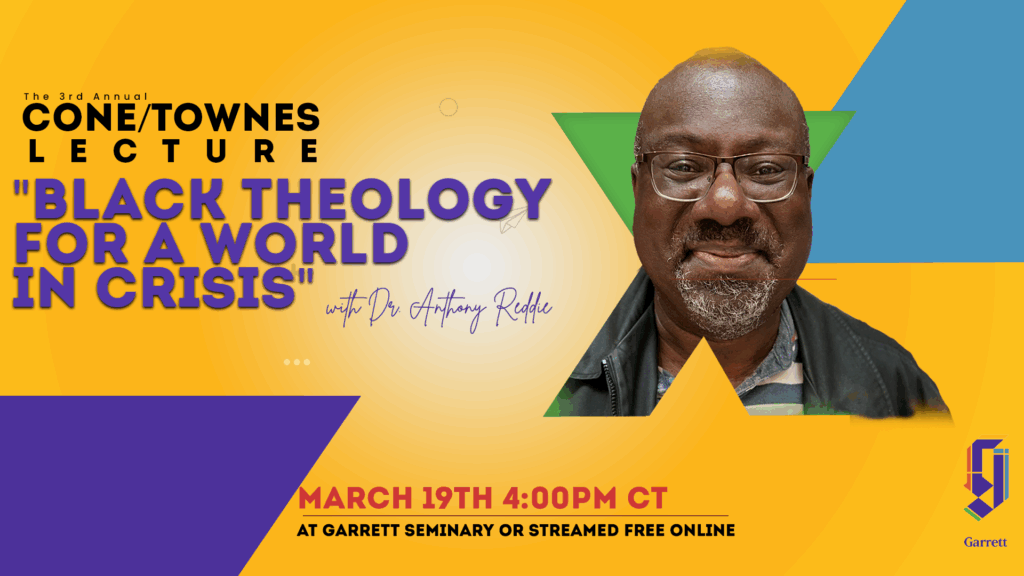
“James Cone and Emilie Townes’ gift is the invitation to participate in a broader struggle.” Dr. Anthony Reddie offers a broad smile as he shares how their trailblazing legacy ignited his own passion for theological inquiry. On March 19, Oxford University’s Professor of Black Theology and director of the Centre for Black Theology will deliver Garrett Seminary’s third annual James H. Cone & Emilie M. Townes lecture. Looking forward to his address, Dr. Reddie is quick to name how both thinkers fundamentally shaped how he understands colonialism and white supremacy. “They’re heroes of mine, whose work profoundly informed and influenced me,” he says. “So, I’ll partly be sharing personal reflections on the significance of their scholarship to my life as a Brit. But I’ll also describe why their work will continue to be crucial, particularly given the rise of nationalism and the ways that a certain type of Christianity have been weaponized.”
If it wasn’t for Dr. Cone, Dr. Reddie might never have become a theologian in the first place. He originally intended to be a dramatist until a chance encounter changed his life forever. “I ducked into an Afrocentric bookshop just to get out of the rain, looking for a place to stay dry,” he laughs. “The book I picked up to kill time was Cone’s co-edited Black Theology anthology vo.1. I read it until the owner of the shop took the book out of my hands with the classic interjection, ‘Sir this is not a library, it’s a bookshop. Either buy the book or put it down.’” Dr. Reddie bought the book, then swiftly purchased A Black Theology of Liberation and Black Theology and Black Power. “Within a few months, that was it,” he reflects. “I didn’t want to be a playwright anymore; I wanted to be a theologian.”
Dr. Cone provided the initial spark, but it was Dr. Townes who nurtured that flame and expanded his sense of what was possible. “Cone may have given me content for Black theology but, right from the outset—because I am much more of a practical theologian and creative writing is part of my background—Townes was more influential for the form of my work,” Dr. Reddie reflects. “I’m very moved by the way she and other womanists use poetry and creative writing more generally, as ways of undertaking Black theological discourse. I even published a book called ‘Dramatising Theology’, in which I used drama as a means of doing Black Theology in Britain. While both scholars primarily address a U.S. context, Dr. Reddie quickly observed how their work also spoke to his experiences as the child of Jamaican immigrants in the United Kingdom. “Black theology has always been clear about what it feels like to be in a body that is seen as problematic,” he notes. “What does it mean to be treated as someone who does not belong, someone whose presence makes other people feel uncomfortable, angry, or disturbed?”
That perspective couldn’t be more timely, as influential politicians across the U.S. and the U.K. vilify migrants for myriad social ills, often dressing that nativism in Christianity’s clothes. “Christianity has a very ambivalent relationship to empire and migration,” Dr. Reddie explains. “At best it has been the means of resistance of those who are on the margines, those who are colonized. At worst, it has been how the empire colonized people.” Black theology, he contends, helps reclaim Jesus from leaders who would wield him for violence. “It locates Jesus not as Christus Victor, the all-powerful Christ who exerts the force of God,” he reflects. “Instead, it’s the Jesus of history—a Jew in the midst of the Roman Empire who’s perceived as a problem within the body politic, which is precisely why he gets crucified.”
In this age of ascendant nationalism, Dr. Reddie expresses appreciation for the way Drs. Cone and Townes resisted the lure to replace one form of hegemony with another. “It’s interesting that neither Cone nor Townes are Black nationalists,” he reflects. “Speaking truth to power means they insist on that work in all occasions, even when it applies to the Black church itself. Particularly for Townes, she’s sharply critical when that institution becomes patriarchal, when it becomes homophobic. Black folks don’t get a pass simply because they’re Black.” He’s also grateful for the way their scholarship encourages all people to participate in God’s work for liberation. “It’s why I will use my experience to help the audience think, ‘How does this map onto your particularities? What similarities do you see?’” he says. “I want them to reflect on how this enables them to participate in the broader project all of us are in.”
As much as he appreciates how Black theology speaks to wider liberation, Dr. Reddie will root his address in how the discipline specifically nurtures and celebrates Black culture. “In the Jamaican context, for example, it helps me see how patois—now officially called the Jamaican language—has always been a form of resistance,” he notes. “For a long time, it was condemned as bad and broken English spoken by poor, working class people. But there’s been a reclamation of that in my context to describe how this comes out of slavery, of people creating their own codes. Put simply, if someone can’t understand what you’re saying, that gives you a degree of agency to plot subversion while still within the white gaze.”
In a moment when Garrett has more international students than ever before, many of whom are navigating their own countries’ legacies of colonialism, Dr. Reddie hopes his story will offer an entry point for how Drs. Cone and Townes can empower that project. “While our stories are not the same, they are more alike than unalike because the issue is power, how what it normative is made central and what gets pushed to the margins is attacked,” he concludes. “It’s an invitation for all of us to collectively put our shoulder to the wheel and be involved in this anti-hegemonic struggle.”
We invite you to join us on March 19 at 4:00 p.m. CST in-person at the Chapel of the Unnamed Faithful or streamed online. Click here to RSVP and receive more information about the lecture.