

Go and Do Likewise: The Garrett Collective Helps Churches Care for Migrants
December 11, 2025
“Our religious practice compels us to live as if love is stronger than hate, hope is stronger than fear and goodness is stronger than evil, even when the opposite appears true. Maybe especially then.”
These words help open an October 28 public letter that five Wilmette, Illinois clergy sent their village board, lamenting how our federal government is treating immigrant neighbors and asking the village trustees to do everything in their power to protect residents under threat. Penned after ICE agents conducted raids in the community, the authors rooted their resistance in fundamental religious values. “We want all people to be welcomed in our community, free to play and work and worship and live up to their potential, in a way that makes God smile,” they wrote. “We call on you to protect our residents, our businesses, our schools, our parks, our houses of worship.” The town responded: More than 180 community members signed up to testify at a public hearing, and the board subsequently passed a resolution to expand civic safeguards. While this movement of Spirit was in some ways a spontaneous outpouring of love, it was also the product of intentional planning—spurred by a day-long training at Garrett as the Garrett Collective director, Rev. abby mohaupt, guided members of local congregations through community organizing tactics.
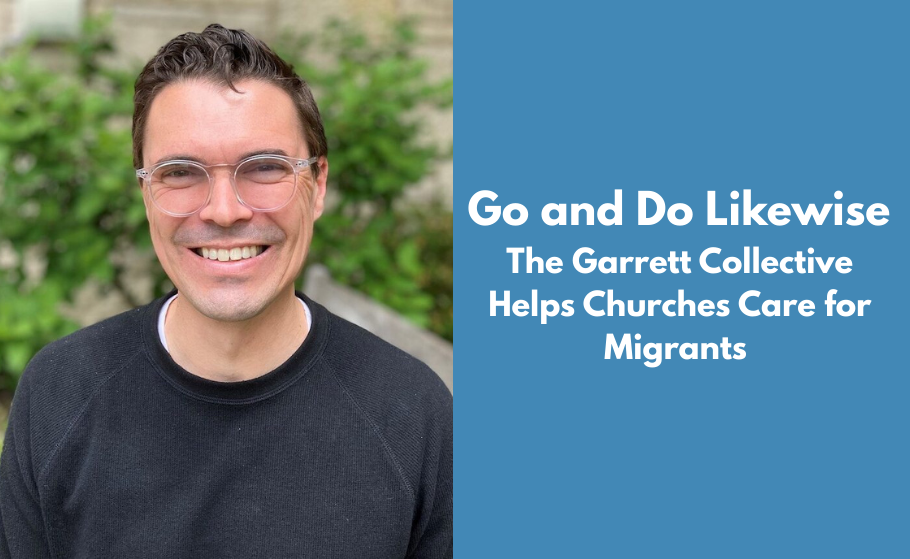
Rev. Jeff Lehn, senior pastor at First Presbyterian Church of Wilmette, helped convene that initial gathering to guide the moral outcry he heard among his congregants. “The situation was fermenting after President Trump’s re-election, and we were wrestling as a community with the question, ‘What is ours to do?’” he reflects. “There’s personal, individual things we all can do, but collectively as a body of Christ in this place, how do we respond with our resources, energy, and time out of commitment to our neighbors who are being harmed?” As his congregation discerned answers to this question, they realized that this calling was bigger than any individual house of worship, so the community decided to gather interfaith partners around this pressing call. Hosting multiple congregations within an individual church changes the balance of power, however, so Rev. Lehn decided to work with the Garrett Collective, providing both a neutral location to meet and expertise in community organizing and facilitation.
The Collective is a new initiative at Garrett that offers resources to clergy, congregations, and lay folks, helping to nurture the faithful work to which they feel called. “abby led us in a six-hour training where we learned how to cut an issue, and how to think about our power and influence,” Rev. Lehn recalls. “In the room, much passion emerged around protecting our immigrant neighbors. Even though many of our congregations have a divergence of political opinions, a central tenet of both Christian and Jewish faith is to welcome the stranger, to treat the immigrant as we would the native-born.” Moving past partisan opinion into moral values helped participants transcend political differences to recognize a shared responsibility. “We ended the training coalescing around the theological conviction that God asks us to look for the image of God in every person, both the person who is being harmed and the person who’s harming,” he says. “The timing of that training was providential: It was only a few days before we faced our first ICE raids here in Wilmette.”
Suddenly, organizing training shifted quickly from theory into practice. “There was so much energy after that gathering, I reached out to interfaith colleagues to whom I’m closest, to draft a letter all of us could sign,” he shares. “Apparently, the letter made quite an impact, and the village admitted we needed to study and make a policy around this.” From there, the group expanded to include ten leaders who met with the police and fire chiefs, coordinating on language for a local ordinance. “Initially, there was a response of ‘Well, there’s nothing we can do,’ and technically that’s true—they can’t intervene,” Rev. Lehn notes. “But we helped them see that they can show up to witness, to make sure laws aren’t being broken, to keep community members safe as they exercise their first amendment rights.” All these provisions and more went before the board in the meeting that drew nearly two-hundred community participants. What began as a training in a seminary classroom became local policy.
As he looks back on the past two months, Rev. Lehn expresses gratitude for how Garrett empowered members of his own church and the wider community. “The Collective provided the resources, the space, the training—all we had to do was show up,” he says. “Of course, we all wanted to help immigrants, but this brought that larger goal into particular focus—getting down smaller and smaller to something we can actually do. Right now, people feel afraid to go to the grocery store, so we’re going to help with Instacart fees.” Effective training doesn’t only provide logistical help, it also offers theological succor. “When we can clarify with specificity, “this is ours to do, maybe just right now, even just today,” and then go do it, you feel some agency,” Rev. Lehn confesses. “You feel like you’re in the flow of God’s spirit and the work of repairing the world. You still feel despair at the scale of the challenges and this widespread calamity we face. But the call is not to cower and withdraw, it’s to notice, then go and do likewise, see what suffering we can alleviate.”
Would you or your congregation benefit from a community organizing training? On January 22, the Garrett Collective will host a webinar to help you explore ways you can work for change. Then, this spring, the Garrett Collective will host a six-week intensive training on “Organizing for People of Faith.” Click here to learn more!