

Coming Home to Jeong
October 1, 2026
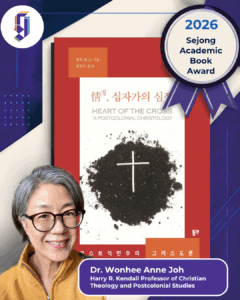
This year, Dr. Wonhee Anne Joh’s landmark book Heart of the Cross: A Postcolonial Christology (Westminster John Knox Press, 2006) was translated into Korean by Dr. Choi Yoojin ’11, and received the prestigious Sejong Academic Book Award. Sponsored annually by the South Korean government, the award recognizes honors excellence in scholarly publishing and seeks to incentivize public reading culture. The Ministry of Culture, Sports, and Tourism purchases thousands of copies of the winning volume, placing them in libraries, government buildings, and other key cultural institutions.
The honor is made even more significant because translated work has rarely won the prize. As with all her publications, Dr. Joh donates 100% of royalties to World Without War—a international peacemaking organization. It’s fitting impact for a book that seeks to nurture collective flourishing. Aware Magazine took the opportunity to interview Dr. Joh about whyshe feels the book is enjoying such a renaissance, and the ways she hopes its message will spread across academia and wider culture. The following transcript has been edited for length and clarity.
For you, what sits at the heart of your book?
I struggled with identity growing up in the US. I kept asking: ‘Who am I? Am I Korean? Am I Korean enough? Am I American enough?’ That kind of oversimplified, bifurcated conversation seems as not critical these days. But back when I was growing up in the 70s and 80s, those questions were so central. They were the dividing lines for one’s authenticity and belongingness. Those questions led me to ask: How do we connect to our roots/routes and ancestors in the diasporic life?
So, in the book, I draw on the Korean notion of jeong. Jeong is more than the Western understanding of love. In Western philosophy and theology, we have these notions of agape, philia , eros. They’re melded together into “love.” But jeong also refers to relations that are really difficult, but where there is still affection for the other.
For example, Nelson Mandela talks about how when he was imprisoned, bonds of humanity developed between himself and the guard he saw every day for years—even though they should have been enemies. When he was inaugurated, the prison guard was there in support.
I witnessed jeong in the Korean American church growing up, and in my relations with Korean people. It’s deeply grounded in the idea of interdependence—I am because we are. Under that frame, cutting off relations doesn’t always work because you still have to reconcile those relations in the end.
Much liberation theology in Korea was done by men, and they emphasized this notion of dan, which refers to severing oppressive ties. But in practice, we don’t really do that. If you’refrom communities that are so besieged, you can’t always let go of the ones that are very difficult to have in your life. Because when you relinquish them, you cast them into a system that is so unforgiving.
Where do you see jeong in the Bible?
I think, as a Judean, Jesus really knew this complexity of jeong. When Judas comes to the garden with people to arrest him, Jesus—who knew this would happen—says to Judas, “You have come for me, friend.” He uses this particular term of friendship. There is sorrow and recognition that the friendship didn’t come through for him in the end, but they’re still not letting go of one another. That, to me, is Jeong.
After 20 years, why do you think the book is having such profound impact right now in the Korean context?
The book came before post-colonial/decolonial criticism emerged widely in the academic context. But the work I was doing on jeong was also ahead of itself. These ideas are finally receiving the kind of attention they deserve. Part of it is also related to Korean cultural ascendancy in the global scene, the ascendancy of Korean cultural soft power in the world. I think the government recognized that contextual work should receive this kind of recognition. They’re practicing their own decolonialism in Korea. For a long time, contextual theology was looked down upon as less than quote-un-quote normative European theology. There has always been rigorous and robust presence of Korean philosophy ad religiosity. Now, there is a more explicit philosophical turn toward honoring indigeneity in Korea, and indigenous spiritual practices. So, in some ways, the translation happened exactly when it needed to. As I wrote in the book’s new preface, it’s finally coming home to be received by the home country, by the place that I wrote about and from where I came.
How has theological academia changed since you wrote the book?
I feel quite vindicated because when I wrote this 20 years ago, I had to make the book accomplish two things. It does contextual decolonial work, but it also does heavy lifting on the “continental philosophy” of the West. At that time, I felt I had to do both in order to be validated in academic circles. I had to know the masters’ tools better than the master, if you will. But in many ways, it was agonizing work for me!
I cover Julia Kristeva’s work. I incorporate French feminists. I draw on deconstructionist thinkers, postcolonial theorists and mainline theologians, folks like Moltmann. At the time, nobody taught post-colonial theory in seminaries. My involvement happened by chance—I was doing my dissertation and I was so bored that I was browsing the English section at Drew’s undergraduate bookstore and came across Homi Bhabha’s The Location of Culture. I started to read and was instantly enraptured. I stopped everything and spent two years on my own educating myself on postcolonial theory.
Theological academia didn’t know what to do with that. I even remember a Korean feminist scholar asking me, “Why do you have to bring in the indigenous stuff? You know, that’s really self-orientalizing.” There was a hesitancy, even a disavowal, by Korean scholars at the time. My response was, ‘Would it be more acceptable if I add a French accent to this?’ This is part of what I’ll discuss at the Center for Asian/Asian-American Ministries’ book talk, because I want our students to know that the authority of your work should not be dismissed as“contextual theology,” because all theology is contextual. I hope the students these days don’t have to do the double lifting that I had to do.
What was it like to work with a translator who is a Garrett alumna?
When I first came to Garrett, I was invited to be on Choi Yoojin’s dissertation committee. It’s funny, at the time she said she didn’t like my book because she was so sick of jeong in Korea and tired of Korean patriarchal ways that deployed Jeong to oppress women because of the relationality that is at the heart of jeong. Then, during the process of her PhD, she had a child and said that becoming a mother completely changed the way she saw the world. She’s actually published other articles using the book as a jumping point and previously translated one of Dr. Bedford’s books—but had always wanted to translate this one. It was such an interesting process, reading the versions she would send. Reading it, I was so moved by her translation choices. The book flows so beautifully, I kept thinking, ‘Who wrote this?!’
It also brings up important questions about labor and compensation. She offered to do this work for free. I couldn’t afford the going rate for her to translate the entire book, but I also told her ‘you can’t do this for free!’ even though she wanted to. We asked publisher what the going rate was as a reference point and we agreed on the rate for teaching one class, which was something I could offer, and which we agreed was a fair fee. Through this very mutual process, we were able to practice reciprocity for the work she offered, but it was also a mentoring opportunity to express: you have to value your professional labor.
Coming back to the book, what can jeong offer a U.S. culture that feels like it’s gone badly off track?
American culture has always tended to forget its roots. There are many roots, right? And that’s what people often try to homogenize. But in that process, there’s an unmourned grief that many Americans embody and it tends to lash out into violence and abjection to anyone who they consider ‘different’ or a hunger to consolidate power.
When we say “America,” that’s not a race—there’s so much diversity within that term. But culturally, there’s presumption that being American means you have no context or ethnicity, as if you were here forever. So we must begin to ask folks, “where are you from?” especially if they haven’t thought about this question that so many of us have to address all the time.We come from elsewhere and we are also now complicit in the ongoing project of settlerism. How should that change our theology?
To decolonize imperial desires we must recognize that we all come from somewhere. We belong somewhere. We have ancestors. Becoming intimate with them allows us to access a theology that’s much more welcoming, expansive and inclusive.
How do you see these understandings playing out in Garrett’s classrooms?
This is what the diversity of international students—and even domestic diversity within the US—enables. It shatters myths of invulnerability. Because if we really want true relations, one where we recognize ourselves in the other, that kind of relationship is only possible when we are willing to be vulnerable. It is only through honest sharing and reflections and theological wanderings that we can open ourselves to receiving the other. Community is made through mutual process. Because if you’re trying to always be invulnerable and wallyourself off, there is no relation. The self-made person is a myth because—in every moment, through every single thing that we do—we are already indebted to the other.
Contexts like the Garrett classroom provide opportunities to recognize that. If you’re in Evanston taking a course with someone from Ghana, in some ways distance becomes a non-issue. Your proximity forms relations.
In what ways would you like to see Garrett grow in this approach?
Hopefully in the future we’ll have more opportunities to also do this work face-to-face.
It can’t all be virtual. To have effective relationship you have to have kinship but also what I call skinship. That means eating meals together or visiting each other. That’s the real challenge ahead. What’s happening in these classrooms is just the beginning of future opportunities for exchange. In biblical stories, people often visit one another’s towns. It’s the basis of entering another people’s heart. Those ways of being with one another sustain intimate relationships and can help them endure for decades.